
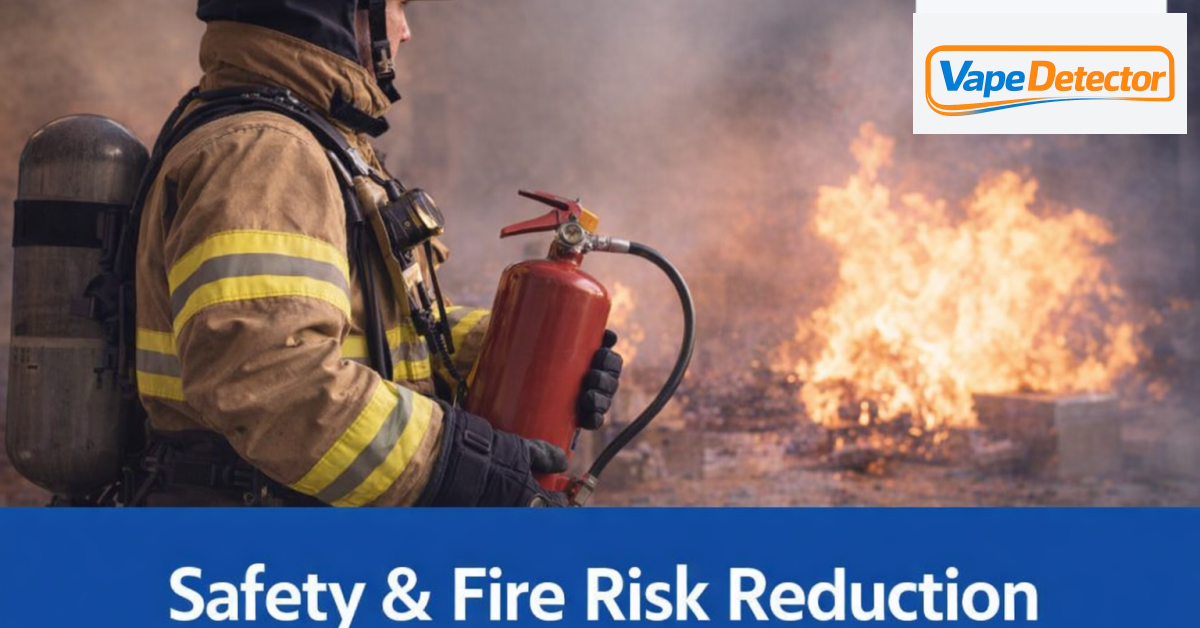
Safety & Fire Risk Reduction
Vaping devices and lithium-ion batteries introduce specific fire and burn risks in homes, vehicles, and workplaces. The highest-risk moments often involve charging, damaged cells, incompatible chargers, or poor storage of spare batteries.
Fire risk reduction for vaping focuses on two areas: preventing overheating and thermal runaway, and detecting hazardous behaviour early enough for staff to intervene safely. Clear controls, suitable equipment, and consistent reporting routes reduce incident frequency and limit consequences when failures occur.
Fire Risk From Vaping Devices And Lithium-Ion Batteries
Lithium-ion cells store high energy in a small space. Mechanical damage, electrical faults, and overheating events trigger rapid failure modes that create heat, flames, toxic smoke, and projectile debris. Fire risk increases when devices are used outside manufacturer limits or charged in unsuitable locations.
Vape risk management works best when controls address typical ignition pathways, likely locations, and early signs of battery distress. Early recognition matters because battery incidents escalate quickly and standard “small fire” assumptions often fail with lithium-ion involvement.
Common Causes Of Vape-Related Fires
Battery incidents usually start with heat generation inside the cell. Heat builds faster when charging is uncontrolled, when the cell is damaged, or when a device draws more current than the battery supports.
Common causes include:
- Use of incorrect or counterfeit chargers and cables.
- Charging from unsuitable power sources, including damaged sockets and overloaded extensions.
- Physical damage to devices, pods, and removable cells, including dents, torn wraps, and crushed casings.
- Short circuits from coins, keys, or other metal objects contacting battery terminals.
- Modifications, mixing battery types, or using cells with unknown provenance.
- Exposure to high temperatures, including direct sunlight on dashboards or near heaters.
Battery safety relies on matching the battery, device, and charger specifications and keeping cells physically intact.
Where Fires Start In Homes, Cars, And Workplaces
Charging areas and storage points often represent the highest probability locations because batteries remain connected to power for extended periods. Confined spaces also concentrate heat and smoke.
Typical origin points include:
- Bedrooms and living areas where devices charge overnight near bedding and upholstered furniture.
- Kitchens where devices charge near combustible packaging and cooking heat sources.
- Cars and vans where devices or spare batteries sit in hot cabins, cup holders, or glove boxes.
- Toilets and changing rooms where concealed use leads to improvised charging and poor ventilation.
- Staff rooms and reception areas where “temporary” charging becomes routine without supervision.
Location risk increases when escape routes, detection coverage, and staff supervision remain limited.
Early Warning Signs Of Overheating And Battery Failure
Battery failure often shows observable symptoms before flame. Fast intervention reduces harm if staff recognise the signals and follow a safe response process.
Early warning signs include:
- Device or battery feeling unusually hot during use or charging.
- Hissing, crackling, popping, or a high-pitched whistle.
- Swelling, bulging, or deformation of the device body, battery, or pod.
- Burning smell, sweet or solvent-like odour, or visible vapour not associated with normal use.
- Discolouration around charging ports, melted plastic, or scorching on cables.
Early warning awareness supports faster isolation and safer escalation.
UK Safety Duties And Compliance For Vape Risk Management
UK dutyholders manage fire risk under health and safety and fire safety legislation. Vaping-related battery hazards fit within broader duties to identify foreseeable hazards, implement controls, and maintain safe premises and safe systems of work.
Compliance improves operational consistency because documented controls set clear expectations for staff, contractors, and visitors. Enforcement risk also increases after an incident if risk assessments, maintenance records, and training evidence are missing.
Health And Safety At Work Act Responsibilities
The Health and Safety at Work etc. Act 1974 places duties on employers to protect employees and others affected by work activities. Vaping device charging at work becomes a workplace hazard when employers permit it, tolerate it, or fail to control it.
Employer controls typically cover:
- Safe electrical arrangements for charging.
- Supervision standards in higher-risk areas.
- Training for staff who respond to overheating devices.
- Reporting and investigation processes after incidents or near misses.
Reasonably practicable controls focus on reducing likelihood and limiting harm without relying on perfect user behaviour.
Regulatory Reform (Fire Safety) Order Requirements
The Regulatory Reform (Fire Safety) Order 2005 applies to most non-domestic premises in England and Wales. Responsible Persons identify fire hazards, assess risks, and implement preventive and protective measures.
Vape-related risks align with core fire safety principles:
- Ignition sources include batteries, chargers, and improvised electrics.
- Fuel includes paper products, seating, bedding, bin waste, and cleaning materials.
- People risk increases where occupants are unfamiliar with the site, asleep, or require assistance.
A fire risk assessment remains effective when it treats battery incidents as a credible ignition scenario, not as a niche issue.
Smoke Control, Evacuation, And Site Fire Procedures
Battery incidents generate dense smoke and irritating by-products. Smoke control and evacuation procedures reduce exposure even when a fire remains small.
Site procedures often cover:
- Door control to limit smoke spread.
- Use of extraction in toilets and small rooms where aerosol and smoke accumulate.
- Clear triggers for evacuation and emergency service attendance.
- Isolation of electrical supplies where safe to do so.
Procedures work best when staff understand decision points and do not attempt unsafe interventions.
Risk Assessment For Vaping And Charging Areas
A practical risk assessment identifies where vaping and charging actually occur, not only where policies allow them. Behaviour-led risk mapping often reveals hidden charging points, informal storage, and routine rule breaches.
Risk assessment outputs support consistent controls, procurement decisions, and staff training priorities. Regular reviews matter because device types, charging habits, and occupancy patterns change over time.
Identifying Ignition Sources And Fuel Loads
Ignition source identification covers both the battery and the charging arrangement. Fuel load assessment focuses on what burns easily nearby and what increases fire growth.
Key checks include:
- Presence of extension leads, multiway adaptors, and damaged sockets.
- Soft furnishings, bedding, paper towel dispensers, and waste bins near charging points.
- Cleaning chemical storage and aerosols in staff cupboards.
- Lockers and drawers used for concealed charging with limited heat dissipation.
A combined ignition and fuel view highlights locations where a small battery failure becomes a fast-developing fire.
Assessing Occupancy Risk And Vulnerable People
Occupancy risk depends on who is present, how quickly they detect smoke, and how easily they evacuate. Vulnerable people include those with mobility limitations, sensory impairments, cognitive impairment, or those who are asleep.
Higher-risk scenarios often include:
- Overnight accommodation and staff sleeping areas.
- Healthcare, care homes, and supported living.
- Crowded venues with low lighting and high background noise.
- Areas where staff work alone and response time increases.
Occupancy assessment helps prioritise early warning measures and stricter charging controls.
Documenting Controls And Reviewing Incidents
Controls remain effective when responsibilities are clear and evidence exists. Incident reviews identify repeat locations, device types, and behaviour triggers that policies did not address.
Documentation typically includes:
- Agreed charging locations and prohibited areas.
- Inspection routines for sockets, cables, and portable appliance use.
- Staff training records and refresher frequency.
- Near-miss reporting forms and corrective action tracking.
A closed-loop review process reduces repeat incidents and strengthens compliance evidence.
Safe Charging Controls And Battery Handling
Safe charging controls address the highest probability point of failure. Charging introduces continuous power, increases internal temperature, and masks early warning signs if devices are left unattended.
Battery handling controls reduce mechanical damage and prevent short circuits. Clear rules also reduce conflict because staff decisions rely on documented standards rather than individual judgement.
Approved Chargers, Cable Quality, And Power Settings
Approved charging equipment reduces electrical stress and overheating. Cable integrity matters because poor-quality or damaged leads create resistance and heat at connectors.
Practical controls include:
- Use of manufacturer-supplied chargers where available.
- Prohibition of unknown, counterfeit, or damaged chargers and leads.
- Avoidance of “fast charge” settings if the device documentation does not support them.
- Separation of charging points from water sources and routine spill areas.
Equipment controls work when sites provide compliant charging options rather than relying on personal chargers of unknown quality.
Charging Location Rules And Fire-Resistant Surfaces
Charging location selection reduces harm if a battery fails. Fire-resistant surfaces and open-air positioning lower ignition probability and improve early detection.
Charging location rules often include:
- No charging on beds, sofas, carpets, or under pillows.
- No charging in toilets, cupboards, or locked rooms where heat and smoke accumulate.
- No charging in escape routes, stairwells, or plant rooms.
- Charging only on non-combustible surfaces with clearance from paper and waste.
Location rules support quicker intervention and reduce fire spread pathways.
Storage Of Spare Cells And Damage Checks
Removable cells and spares introduce additional risk because terminals short easily and damage is not always obvious. Storage controls focus on preventing contact with metal and preventing crushing.
Recommended practices include:
- Storage of spare cells in purpose-made cases, not loose in pockets or bags.
- Visual checks for dents, corrosion, torn wraps, and leaking.
- Removal from service of any battery that overheats, swells, or shows damage.
- Separation of damaged devices from routine storage to avoid re-use.
Physical integrity and terminal protection remain the most important storage controls.
Disposal And Recycling Of Batteries And Devices
Damaged or end-of-life batteries require controlled disposal. General waste disposal increases fire risk in bins, compactors, and waste vehicles.
Disposal controls typically include:
- Use of approved battery recycling routes for lithium-ion cells.
- Isolation of damaged batteries in a non-combustible container, away from combustibles, pending specialist disposal.
- Prohibition of crushing, puncturing, or dismantling devices.
- Clear staff roles for handling found or confiscated devices.
Correct disposal reduces secondary fires in waste streams and protects waste-handling staff.
Vape Detectors And Sensors For Early Warning
Vape detectors provide early warning where concealed vaping and charging occur, especially in toilets and changing areas. Early detection supports faster staff intervention and reduces the time a faulty device remains unnoticed.
Detection works best as part of a wider safety system that includes ventilation, clear policies, and incident response. Detector choice and placement also affect false alert rates and staff confidence.
For a practical overview of what these systems can and cannot do in real sites, see benefits and limitations of vape detectors.
What A Vape Detector Measures
Vape detectors measure changes in air associated with vaping aerosol. Many devices use sensors that respond to particulate matter or volatile organic compounds associated with vapour clouds.
Vape detection differs from smoke detection because vaping aerosol behaviour differs from combustion smoke. A detector setup that targets vaping use supports early staff attendance before charging hazards escalate unnoticed.
Sensor Types And Placement Considerations
Sensor selection and placement depend on room size, airflow, and typical user behaviour. Toilets, cubicles, and corridors behave differently because ventilation extracts air at different rates.
Placement considerations include:
- Distance from extract vents that remove aerosol before detection.
- Avoidance of direct exposure to steam sources that trigger alerts.
- Positioning that covers cubicle areas while remaining reachable for maintenance.
- Use of separate zones for clusters of toilets to aid accurate location reporting.
Correct placement improves detection reliability and reduces time spent investigating incorrect areas.
Reducing False Alerts While Maintaining Coverage
False alerts reduce staff confidence and increase response delays. False alerts often come from aerosols, deodorant sprays, steam, and cleaning chemicals.
Control measures include:
- Calibration settings that match room conditions and ventilation rate.
- Clear rules restricting aerosol sprays in monitored spaces where feasible.
- Maintenance routines that prevent sensor contamination.
- Alarm routing that allows staff verification without disrupting the entire site unnecessarily.
Balanced tuning maintains coverage while keeping response practical for staff teams.
Integrating Vape Detection With Fire Alarm Systems
Integration decisions affect escalation speed and the consequences of alarms. Many sites route vape detector alerts to staff pagers, building management systems, or separate panels rather than activating a full fire evacuation.
Integration options typically consider:
- Whether vape alerts remain informational or trigger a managed response.
- How alerts log time, location, and repeat events for safeguarding and compliance.
- Whether escalation links to fire procedures when smoke or heat detection also activates.
A clear integration plan supports proportionate response while maintaining safety priorities.
Ventilation And Indoor Air Safety Measures
Ventilation controls address aerosol build-up and reduce lingering vapour that encourages repeat use in hidden areas. Ventilation also supports early identification because odour and haze persist less in well-ventilated rooms.
Indoor air controls matter in workplaces and public premises because vapour and smoke exposure affects staff and visitors, especially in small rooms with limited extraction.
Managing Aerosol Build-Up In Toilets And Small Rooms
Toilets and small rooms concentrate aerosol because volumes are low and doors remain closed. High aerosol levels also increase the chance of masking early signs of battery overheating.
Effective measures include:
- Ensuring extraction operates continuously or for sufficient timed periods.
- Keeping door undercuts clear to allow make-up air.
- Reducing concealed congregation points through layout and supervision where appropriate.
Aerosol control supports both health and behavioural management outcomes.
Mechanical Ventilation Checks And Maintenance
Mechanical ventilation performance declines with blocked grilles, failed fans, and poor commissioning. Routine checks maintain actual airflow rather than relying on design intent.
Maintenance actions often include:
- Inspection of extract fans, grilles, and ductwork for blockage.
- Verification of timer settings and occupancy sensors where installed.
- Recording of faults and repair timescales.
Reliable ventilation reduces nuisance alerts and supports faster clearance after incidents.
Signage And Access Control For High-Risk Areas
Signage reinforces rules and supports consistent enforcement. Access control reduces unsupervised time in higher-risk areas where charging or vaping occurs.
Common controls include:
- Clear “no charging” notices in toilets, changing rooms, and plant spaces.
- Staff-only access for certain welfare areas where appropriate for the site.
- Patrol patterns that reflect incident history rather than fixed schedules.
Behaviour controls work best when they align with observed risk locations.
Fire Safety Equipment And Response Planning
Battery incidents require a response that prioritises life safety and smoke management. Equipment and planning reduce confusion when staff face fast-developing heat, noise, and smoke.
Response planning also reduces injury risk to staff who attempt to move or extinguish a failing device. Clear triggers for evacuation and emergency service calls improve consistency.
Extinguishers And Fire Blankets For Battery Incidents
Fire extinguishers support initial response where staff training and risk assessment support their use. Fire blankets help smother small burning items, but lithium-ion failures sometimes re-ignite.
Site decisions typically align equipment selection with staff competence and location risk. Suitable equipment positioning matters because staff do not cross smoke-filled areas to retrieve extinguishers.
Battery incident planning also accounts for cooling and re-ignition risk after visible flames stop.
Isolation, Evacuation, And Incident Escalation
Isolation reduces ongoing electrical input during charging failures. Evacuation reduces smoke exposure and prevents crowding near the incident.
Escalation procedures often include:
- Immediate separation of people from the device if hissing, smoke, or flame appears.
- Electrical isolation at the socket if safe and accessible.
- Calling emergency services when smoke increases, flames appear, or the device involves structural materials.
Clear escalation thresholds support consistent decision-making under pressure.
Post-Incident Actions And Evidence Preservation
Post-incident actions reduce recurrence and support investigations. Evidence preservation also supports insurance and enforcement enquiries where relevant.
Post-incident actions typically include:
- Securing the device and charger in a safe, non-combustible container if safe to do so.
- Photographing the location, damage, and power source without handling unsafe items.
- Recording time, witnesses, and actions taken.
- Checking nearby sockets and furniture for heat damage.
Structured follow-up turns an incident into actionable controls rather than a one-off event.
Policies, Training, And Behaviour Controls
Policies define what is permitted and what triggers intervention. Training ensures staff recognise unsafe behaviours and respond consistently across shifts.
Behaviour controls reduce conflict because staff enforce documented site rules. Reporting routes also support safeguarding and welfare approaches where vaping involves minors or vulnerable people.
Clear Rules For Staff, Visitors, And Students
Rules work best when they name locations, not only behaviours. Clear rules also cover possession, charging, and disposal, not only vaping use.
Policy content often includes:
- Permitted vaping areas, if any, and prohibited spaces.
- Charging rules, including approved locations and banned adaptors.
- Confiscation and storage arrangements where applicable.
- Actions after repeated breaches, aligned with HR or student conduct procedures.
A single set of location-specific rules reduces inconsistent enforcement.
Training For Recognising Unsafe Charging And Device Damage
Training reduces response time and improves safety outcomes. Staff knowledge needs to cover both detection and response, including what not to do.
Training topics often include:
- Recognising overheating signs and damaged battery indicators.
- Safe isolation steps and when to evacuate.
- Handling of found devices and loose cells.
- Reporting requirements and evidence capture.
Regular refreshers maintain competence where staff turnover is high.
Reporting Routes And Disciplinary Processes
Reporting routes reduce under-reporting and improve trend analysis. Disciplinary processes set predictable consequences for repeated unsafe behaviour.
Operational reporting often covers:
- Near-miss reporting for hot devices and damaged chargers.
- Logging of vape detector activations with time and location.
- Escalation routes to premises, safeguarding, HR, or security teams.
Consistent reporting supports targeted controls rather than broad, disruptive measures.
Sector-Specific Considerations
Different sectors face different behaviour patterns, occupancy risks, and enforcement constraints. Sector-specific planning improves relevance and reduces unintended consequences, such as displacement of charging to more hazardous locations.
Controls work best when they fit daily routines, supervision levels, and legal duties for the setting.
Schools, Colleges, And Toilets
Schools and colleges often see concealed vaping in toilets and stairwells. Toilets also present high aerosol triggers from sprays and cleaning products, so sensor placement and calibration matter.
Safeguarding processes often influence response. Staff procedures typically separate immediate safety actions from any later conduct or safeguarding steps.
Healthcare And Care Settings
Healthcare and care settings include vulnerable occupants and complex evacuation requirements. Oxygen use and medical equipment increase the need for strict control of ignition sources and smoking and vaping behaviour.
Charging controls in staff areas matter because incidents in back-of-house spaces still threaten patients through smoke spread and service disruption.
Hospitality, Nightlife, And Public Venues
Hospitality venues often combine high occupancy, low lighting, and noise that delays detection and slows communication. Toilets and queue areas often become repeat incident points.
Managed response becomes important because unnecessary evacuations carry safety risks. Clear escalation criteria help staff distinguish vape alerts from fire alarm conditions.
Warehouses, Logistics, And Company Vehicles
Warehouses introduce ignition and fuel combinations, including packaging, racking, and battery charging areas for other equipment. Company vehicles add heat exposure, vibration, and storage of loose items that short terminals.
Vehicle policies benefit from specifying how drivers store spare devices and prohibiting loose battery storage with tools, coins, or keys.
FAQs
What Causes A Vape Battery To Catch Fire?
A vape battery catches fire when internal heat rises faster than the battery dissipates it. Charging faults, short circuits, physical damage, and manufacturing defects trigger thermal runaway, which releases heat and flammable gases.
Is It Safe To Charge A Vape Overnight?
Overnight charging increases risk because devices remain unattended for longer and faults take longer to notice. A safer approach uses manufacturer-approved chargers, supervised charging when awake, and non-combustible surfaces away from bedding and soft furnishings.
Do Vape Detectors Reduce Fire Risk Or Only Detect Use?
Vape detectors primarily detect vaping aerosol, not heat or flame. Vape detectors reduce fire risk indirectly by identifying concealed use and associated unsafe charging behaviours earlier, which supports faster staff intervention.
Where Should Vape Detectors Be Installed For Safety?
Vape detectors suit areas where concealed vaping and charging occur, especially toilets, changing rooms, and other small rooms with repeated incidents. Placement accounts for ventilation effects, likely user positions, and maintenance access so alerts remain reliable.
What Should Staff Do If A Device Starts Hissing Or Smoking?
Staff actions prioritise separation from people and escalation. Staff move people away, isolate power at the socket if safe, and trigger the site’s emergency response, including calling emergency services when smoke or flames develop.
Conclusion
Safety and fire risk reduction for vaping depends on controlling charging, preventing battery damage, and identifying hidden high-risk locations. UK dutyholders support those outcomes through documented risk assessments, practical site procedures, and staff training that matches real behaviour patterns.
Vape detectors and ventilation measures add early warning and improve indoor conditions, but prevention remains centred on safe equipment, safe locations, and consistent enforcement. A combined approach reduces incident likelihood and limits harm when failures occur.