
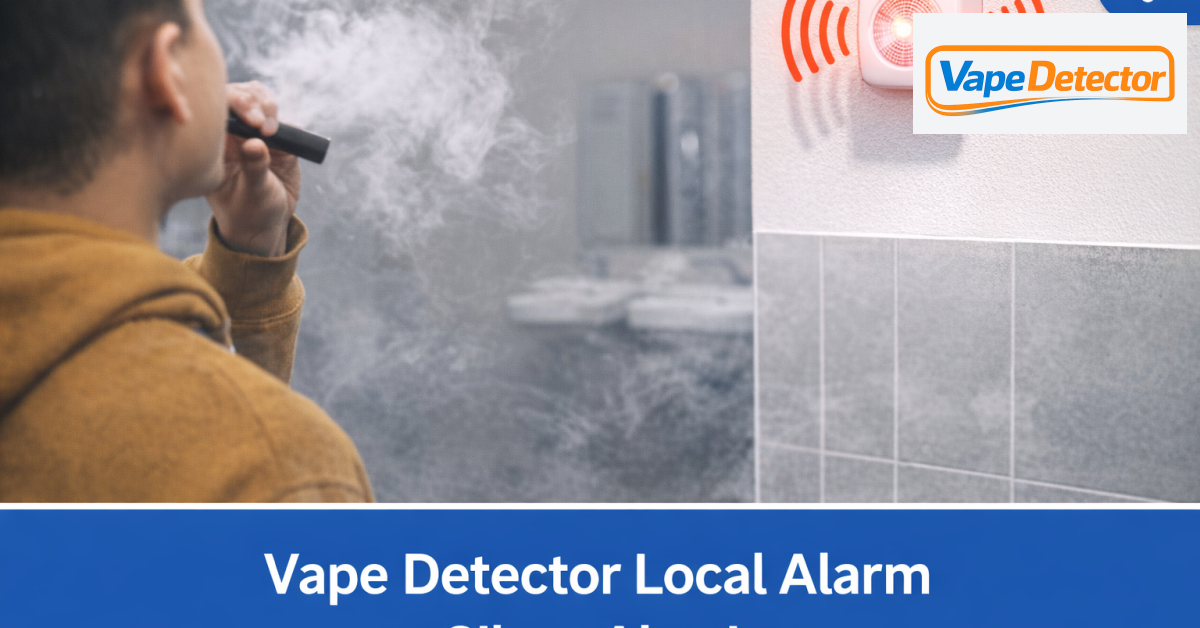
Vape Detector Local Alarm vs Silent Alerting
Local alarms and silent alerting solve different safeguarding problems. A local alarm creates an immediate, on-site deterrent. Silent alerting prioritises discreet intervention and controlled escalation. The right choice depends on risk, staffing, and the site’s tolerance for noise and disruption, plus how alerts route into existing building and security processes.
Key Terms And Alert Types
A vape detector alert either notifies people nearby (local) or notifies nominated responders remotely (silent). Many sites use both, but the terms often get mixed with wiring and integration features. Clear definitions help procurement, installation, and incident response.
What A Local Alarm Means
A local alarm is an audible sounder and or visual beacon triggered at or near the detector location.
What Silent Alerting Means
Silent alerting sends notifications to staff through an app, email, SMS gateway, or control room without on-site noise.
What “Relay Output”, “BMS”, And “Network Alert” Mean In Practice
Relay output provides a dry contact to trigger third-party systems. A BMS is a building management system that receives status and alarms. Network alerting uses IP connectivity to route events to software or monitoring points.
How Vape Detectors Trigger Alerts
Vape detectors convert a detection event into an alarm state based on configured thresholds and time delays. Alert behaviour then depends on whether the device drives a sounder beacon, a relay, or a network message. Understanding the sequence supports predictable response and reduces nuisance activations.
Detection Event To Alarm Sequence
A detection event becomes an alarm after the device applies its sensitivity, confirm time, and any lockout or cooldown.
On-Device Sounders And Beacons
On-device sounders and beacons provide immediate local notification, usually with configurable volume, flash pattern, and duration.
Networked Notifications And Escalation Paths
Networked notifications route to defined recipients, then escalate by time, acknowledgement, or repeated triggers.
Local Alarm: Where It Fits Best
Local alarms suit environments where immediate deterrence matters and staff presence nearby is likely. Audible alerts also help pinpoint the location quickly, which reduces search time. Noise, disruption, and potential confrontation risk still need assessment before choosing an audible approach.
Use Cases In Schools And Colleges
Schools and colleges use local alarms where rapid deterrence and clear boundaries support behaviour management and safeguarding.
Use Cases In Toilets, Changing Rooms, And Corridors
Toilets, changing rooms, and corridors benefit when staff need a quick cue to investigate nearby zones.
Strengths And Trade-Offs Of Audible Alerts
Local alarms deter quickly but increase disruption and can prompt evasion, tampering, or group attention.
Silent Alerting: Where It Fits Best
Silent alerting suits sites that need discretion, calm management, and controlled escalation. Remote alerts also support locations with limited staff presence nearby. Silent systems rely on reliable connectivity and clear ownership of responses to avoid missed or delayed interventions.
Use Cases In Hospitals, Care Homes, And Libraries
Hospitals, care homes, and libraries use silent alerts to minimise disturbance and manage incidents with dignity.
Use Cases Where Discretion And De-Escalation Matter
Discreet alerts help when a visible confrontation increases risk or when privacy and reassurance are priorities.
Strengths And Trade-Offs Of Silent Notifications
Silent notifications reduce disruption but depend on coverage, acknowledgement, and responder availability.
Choosing Between Local Alarm And Silent Alerting
Selection depends on risk, response capability, and how the site operates day to day. A consistent rule-set avoids different outcomes between areas with similar risks. Governance matters because alert data, access rights, and audit trails affect safeguarding and accountability.
- Risk profile and safeguarding requirements define deterrence versus discretion.
- Staffing and response time determine whether silent alerts get acted on quickly.
- Site layout and noise levels influence audibility and practicality.
- Privacy and governance shape who receives alerts and how records are handled.
Local and silent options often work best when aligned to specific zones and response owners.
Risk Profile And Safeguarding Requirements
Higher confrontation risk favours discreet response. Higher repeat offending in known hotspots favours stronger deterrence controls.
Staffing, Response Time, And Coverage
Silent alerting needs named responders and back-up recipients when staff move, go off shift, or lose signal.
Site Layout, Noise Levels, And Occupancy Patterns
High ambient noise and multiple partitions reduce effective local alarm coverage and complicate locating the source.
Privacy, Data Handling, And Governance Considerations
Governance sets recipient lists, retention rules, and access controls for logs and integrations.
If you need to compare device capabilities before deciding, use our feature comparisons to check which models support local sounders, relays, and network alerting.
Installation And Integration Considerations
Installation choices affect reliability and total cost more than the alert type alone. Power, cabling, and network availability determine whether alerts remain consistent across all areas. Integration planning also reduces duplicated alarms, unclear responsibility, and untested workflows.
- Power options and cable runs set coverage and installation disruption.
- Third-party connections need clear trigger rules and isolation.
- Mobile alerts require strong Wi‑Fi or mobile signal in target zones.
- Testing and fault reporting confirm end-to-end performance.
A workable design aligns detector placement with real response routes and maintenance access.
Power Options And Cable Runs
Mains power supports consistent operation. Cable routes and containment affect install time and where devices can sit.
Connecting To Fire Alarms, Access Control, Or CCTV
Integration uses relays or network APIs, with defined rules to avoid triggering life-safety systems inappropriately.
Mobile Alerts, Email, And Control Room Workflows
Workflows need acknowledgement, escalation, and handover between shifts to prevent unattended alerts.
Testing, Maintenance, And Fault Reporting
Scheduled tests verify detection, sounders, network delivery, and any relay actions, plus fault visibility to estates or IT.
Common Setups And Decision Examples
Common configurations map alert type to zone risk and staffing. Simple setups reduce training needs, while hybrid setups increase control but add configuration work. Decision examples help define consistent rules across similar spaces.
- Local alarm only for high-deterrence hotspots with nearby supervision.
- Silent alerting only for low-disruption environments with reliable responders.
- Hybrid escalation where silent alerts precede an on-site alarm if unacknowledged.
- Multi-zone rules that change by time of day and occupancy.
Consistency across buildings reduces confusion during incidents.
Local Alarm Only
Local-only setups prioritise deterrence and quick location finding but need a plan for disruption and false activations.
Silent Alerting Only
Silent-only setups prioritise discretion and controlled response but rely on connectivity and clear escalation ownership.
Hybrid Escalation: Silent First, Local Second
Hybrid escalation sends a silent alert first, then triggers a local alarm after a set delay or repeated detections.
Multi-Zone Rules And Time-Based Alerting
Time-based rules adjust recipients and escalation for lessons, visiting hours, nights, or low-staff periods.
Common Problems And How To Avoid Them
Most failures come from configuration and workflow gaps, not sensor hardware. Sensitivity set too high increases nuisance alerts. Escalation set too low causes alarm fatigue. Connectivity gaps create missed notifications. Sounder placement errors make local alarms ineffective.
- Tune sensitivity with real-world testing in each zone.
- Limit recipients and add escalation rules to reduce fatigue.
- Verify Wi‑Fi and mobile coverage where alerts are expected.
- Position sounders for audibility outside the room, not inside a cubicle.
A short commissioning phase usually prevents repeat call-outs and unclear incident logs.
Nuisance Alerts And Sensitivity Settings
Nuisance alerts often follow poor baseline calibration, aerosols from cleaning products, or airflow effects near vents.
Over-Alerting And Alarm Fatigue
Too many recipients and repeated notifications reduce response speed and increase ignored alarms.
Missed Alerts Due To Network Or App Issues
Missed alerts happen when devices lack network resilience, phones block notifications, or shift handover leaves no active recipient.
Poor Sounder Placement And Audibility Gaps
Sounders placed behind closed doors or inside high-noise areas fail to notify staff in time.
FAQs
Does A Local Alarm Reduce Vaping More Than Silent Alerts?
Local alarms deter immediately, but outcomes depend on supervision, enforcement consistency, and whether alerts trigger timely intervention.
Can One Vape Detector Support Both Local Alarm And Silent Alerting?
Many detectors support both by using an on-device sounder and a relay or network notification at the same time.
Can Silent Alerts Integrate With A BMS Or Security Control Room?
Silent alerts integrate through relay outputs, IP integrations, or monitoring software, subject to the site’s network and access controls.
Do Local Alarms Create Behavioural Or Safeguarding Risks?
Local alarms increase visibility and may escalate behaviour in some settings, so risk assessment and staff response procedures matter.
Conclusion
Local alarms suit deterrence and quick on-site awareness, while silent alerting suits discreet, managed intervention. The best decision follows the site’s safeguarding risk, response capacity, and integration needs. Clear rules, reliable connectivity, and tested workflows keep either approach effective and proportionate.