
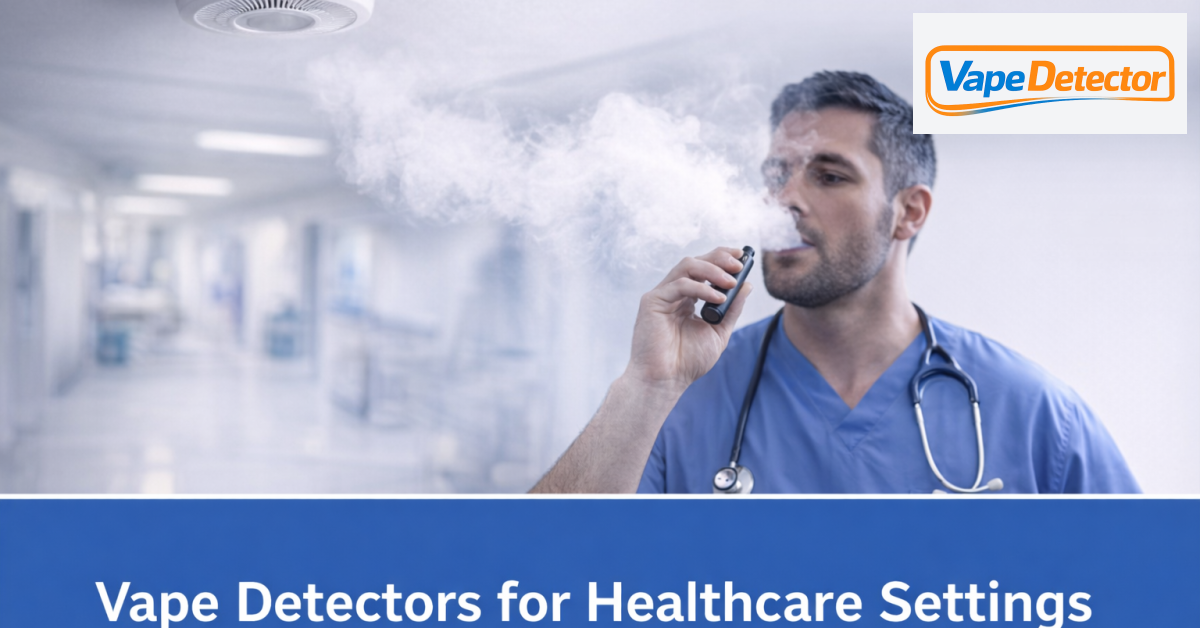
Best for Healthcare Settings
Vape detectors in hospitals and clinics support smoke-free policies where vulnerable patients, complex workflows, and shared airspaces raise the impact of indoor vaping. Healthcare estates also include high-risk areas such as patient toilets, secure wards, and oxygen storage routes, where fast detection helps staff intervene early. Effective use depends on realistic placement, clear alert routing, and well-defined staff procedures, alongside information governance and maintenance planning.
Why Healthcare Sites Use Vape Detectors
Healthcare organisations use vape detectors to reduce exposure risks, protect clinical spaces, and improve incident visibility. Vaping creates aerosols and odours that affect patients, staff, and infection-control routines. Detectors also support consistent enforcement across large estates where staff cannot observe every corridor, toilet, or entrance. Clear reporting helps teams evidence trends and target prevention activity.
Patient Safety And Clinical Risk
Vape aerosol affects respiratory patients and can aggravate symptoms in enclosed areas. Clinical risk increases when vaping occurs near oxygen therapy, around paediatrics, or close to immunocompromised patients.
Fire Safety And Oxygen-Rich Environments
Oxygen-enriched areas increase ignition risk from heat sources and careless handling. Early alerts help staff intervene before behaviour escalates into a safety event.
Safeguarding, Behaviour, And Visitor Management
Vaping sometimes links to concealed behaviour in toilets or stairwells. Alerts support faster staff checks and improve visitor management in busy public areas.
Compliance And Incident Reporting
Incident logs support internal governance and help demonstrate policy enforcement. Time-stamped data supports trend analysis by ward, time, and location.
Similar safety and safeguarding drivers apply in care homes, where shared air and vulnerable residents make early intervention important.
Where Vaping Happens In Healthcare Buildings
Vaping usually occurs in places with low supervision, easy exit routes, or privacy. Healthcare sites combine public access with restricted clinical zones, so hotspots vary by building layout, staffing levels, and visiting hours. Identifying common locations informs detector placement and reduces wasted coverage in low-risk areas.
Wards, Bays, And Patient Toilets
Patient toilets provide privacy and often have extract ventilation that disperses aerosol into corridors. Ward bays also see discreet use when curtains and noise reduce visibility.
A&E, Waiting Areas, And Entrances
A&E waiting times increase rule-breaking, especially near entrances. Entrances create boundary confusion between outdoor smoking areas and indoor space.
Staff Areas, Changing Rooms, And Break Rooms
Staff break rooms and changing areas sometimes see policy breaches during short breaks. Door-closed rooms reduce passive supervision.
Mental Health Units And Secure Wards
Secure settings face higher safeguarding risk and restricted movement, which concentrates incidents indoors. Alerts help staff respond without relying on patient reporting.
Car Parks, Stairwells, And Service Corridors
Stairwells and service corridors offer concealment and quick escape routes. Multi-storey car parks also create semi-enclosed spaces where smoke-free rules apply.
How Vape Detectors Work In Hospitals And Clinics
Vape detectors identify changes in airborne particulates and related environmental signals associated with vaping. Healthcare environments add complexity because disinfectants, steam, and medical aerosols also generate airborne particles. Effective deployment depends on selecting suitable sensors, setting appropriate thresholds, and confirming performance with on-site baseline readings.
What A Vape Detector Measures
A vape detector measures airborne particulates and sometimes volatile compounds, depending on model. Alarm logic uses rate-of-change patterns rather than a single static reading.
Sensor Types Used In Healthcare Environments
Optical particle sensors are common for aerosol detection. Some devices combine multiple sensors to improve discrimination in humid or chemical-cleaning environments.
Alarm Logic, Thresholds, And Reducing False Alerts
Alarm logic applies thresholds, time windows, and verification rules to avoid brief spikes. Site-specific tuning reduces nuisance alerts in toilets, showers, and high-traffic corridors.
Detection Limits And What Detectors Do Not Detect
Detectors do not confirm the user identity or the exact product used. Performance drops with strong extraction, open windows, or very large rooms with rapid air dilution.
Key Features To Specify For Healthcare Use
Healthcare settings need detectors that tolerate tampering, integrate with existing systems, and support audit requirements. Facilities teams also need resilience against power loss and clear fault reporting. Selecting features by use-case avoids overspending on functions that do not support clinical workflows.
- Tamper-resistant casing and discreet siting for toilets and corridors
- Fast alerts with configurable escalation for staff response
- Time-stamped logs that support investigations and trend review
- Battery backup and fault reporting for continuity
Feature selection works best when estates, clinical leads, and security agree response expectations upfront.
Discreet Installation And Tamper Resistance
Low-profile devices reduce attention and interference. Tamper switches and secure fixings protect units in public and behavioural-health areas.
Fast Alerting And Escalation Options
Short alert delays reduce repeated vaping and improve safeguarding response. Escalation rules support handover when the first responder is unavailable.
Data Logging, Time Stamps, And Audit Trails
Logs support incident reporting and help identify repeat locations. Audit trails also support maintenance checks and sensor fault investigations.
Battery Backup And Power Resilience
Battery backup maintains detection during local power issues. Power resilience matters in older estates with variable circuits.
Accessibility And Clear On-Site Indication
Clear indicators help staff identify the source area quickly. Accessibility includes readable status cues for mixed lighting and shift conditions.
Integrations And Alert Routing
Alert routing determines whether vape detection becomes actionable or ignored. Healthcare teams often require silent alerts to avoid escalation in wards, alongside integration into existing clinical and estates workflows. Routing also needs role-based visibility to prevent unnecessary disruption while keeping accountability.
Nurse Call, BMS, And Fire Alarm Interfaces
Nurse call integration supports rapid response in clinical areas. BMS integration supports estates monitoring and maintenance visibility, while fire alarm interfacing requires careful design to avoid inappropriate activation.
Local Sounders Vs Silent Alerts
Local sounders deter behaviour but risk distress in wards and waiting areas. Silent alerts suit clinical areas where de-escalation and privacy matter.
SMS, Email, And App Notifications
Mobile alerts reach security and duty managers during out-of-hours periods. Notification design needs clear location detail to avoid wasted response time.
Zoning And Role-Based Alerting
Zoning groups devices by ward, floor, or department. Role-based routing limits alerts to staff responsible for that area.
Placement And Coverage Planning
Placement drives detection reliability more than headline specifications. Ventilation rates, door usage, and room size affect how quickly aerosol reaches a sensor. Planning also reduces false alerts by avoiding known aerosol sources and by matching coverage to realistic risk.
Room-Level Coverage Vs Corridor Coverage
Room-level coverage works best for toilets, bays, and break rooms. Corridor coverage suits stairwells and shared routes but provides weaker location certainty.
Mounting Height, Ventilation, And Airflow Effects
Mounting height affects exposure to rising aerosol and extraction flows. Strong ventilation can dilute signals, so placement near likely source areas often improves performance.
High-Risk Area Prioritisation
Priority areas include patient toilets, secure wards, and entrances. Estates teams gain faster impact by targeting hotspots first.
Pilot Testing Before Full Rollout
Pilot testing validates thresholds against local cleaning routines and ventilation. A pilot also tests whether alert routing matches staffing reality.
Managing False Positives In Clinical Environments
False positives reduce trust and slow response. Clinical sites contain frequent aerosol sources from cleaning, humidity, and medical treatments. Managing nuisance alerts requires a mix of placement choices, threshold tuning, and operational coordination with ward routines.
Aerosols From Cleaning Products And Disinfectants
Sprays and fogging processes create particle spikes. Scheduling and alternative application methods reduce alert frequency in sensitive zones.
Steam, Humidity, And Shower Rooms
Steam from showers and high humidity affects optical sensors. Toilet and shower area placement benefits from site-specific tuning and careful siting away from vents.
Nebulisers And Medical Aerosols
Nebuliser treatments generate medical aerosols that resemble vaping signals. Clinical teams need agreed response rules where treatments occur.
Kitchenettes And Staff Break Areas
Cooking fumes and toaster smoke create brief spikes. Detectors placed away from kitchenettes reduce nuisance alarms without losing coverage in adjacent corridors.
Policies, Procedures, And Staff Response
Response procedures turn detection into consistent outcomes. Healthcare sites need a proportionate approach that considers patient condition, safeguarding, and de-escalation. Clear roles also protect staff time by preventing repeated call-outs without follow-up actions.
Triage Approach And De-Escalation
Triage assigns the right responder based on area risk, time of day, and patient acuity. De-escalation reduces conflict in waiting areas and behavioural-health settings.
Signage And Patient Communication
Signage sets expectations and reduces disputes. Staff communication works best when it links to safety and comfort, not punishment.
Evidence Handling And Record Keeping
Record keeping supports incident reviews and repeat hotspot identification. Evidence handling needs consistency, especially in safeguarding contexts.
Maintenance Responsibilities And Escalation Paths
Defined ownership prevents unresolved faults and repeated false alarms. Escalation paths link ward staff, estates, and security with clear time targets.
Data Protection And Privacy Considerations
Privacy requirements affect sensor settings, log access, and retention. Healthcare organisations apply information governance controls, especially where devices include optional microphones or add-on analytics. Clear documentation reduces complaints and supports lawful, proportionate monitoring.
Audio, Video, And Microphone Settings
Many vape detectors operate without audio or video. Optional microphone features require careful governance and clear configuration control.
Logging And Retention Periods
Retention periods need a defined purpose, such as incident management or trend analysis. Shorter retention reduces risk when long-term storage adds no operational value.
Access Controls And Information Governance
Access controls limit logs to authorised roles. Governance documentation should match actual system permissions and audit capability.
For a practical overview of privacy considerations, align your configuration, access controls, and retention periods with your organisation’s information governance policies.
Procurement And Total Cost Of Ownership
Procurement decisions depend on more than unit price. Healthcare estates incur costs for installation, connectivity, maintenance, and support. A total cost view also reduces operational risk by confirming availability of spares, service response times, and firmware update policies.
Hardware, Licences, And Connectivity Costs
Costs include devices, any recurring licences, and network connectivity. Wi-Fi, Ethernet, and cellular options each affect estates workload and reliability.
Installation, Commissioning, And Training
Installation costs vary by cabling routes and access constraints in occupied wards. Training needs to cover both response staff and maintenance teams.
Ongoing Calibration, Servicing, And Spares
Some models need periodic calibration or performance verification. Spares planning reduces downtime in high-risk areas.
Evaluating Suppliers And Support SLAs
Supplier SLAs matter for fault response and replacement times. Support evaluation includes documentation quality and change-control discipline.
To narrow options quickly, review comparisons and best for guidance alongside your clinical risk, integration needs, and budget.
Commissioning, Testing, And Maintenance
Commissioning confirms detectors behave as expected in real airflow and real routines. Maintenance preserves confidence by catching drift, faults, and connectivity loss early. Documentation also supports audits and reduces repeated troubleshooting.
Acceptance Testing And Baseline Readings
Baseline readings capture normal conditions for each area. Acceptance testing confirms alert thresholds and routing reach the correct roles.
Routine Testing Schedule And Documentation
Routine testing checks sensor response, power resilience, and communications. Documentation provides a clear history for incidents and compliance reviews.
Firmware Updates And Change Control
Firmware updates affect sensitivity and connectivity. Change control records versions, dates, and any threshold changes.
Fault Monitoring And Downtime Handling
Fault monitoring flags loss of power, network, or sensor health. Downtime handling needs temporary mitigations for high-risk zones.
FAQs
Are Vape Detectors Suitable For Patient Toilets?
Patient toilets are common hotspots, so dedicated coverage often makes sense. Placement needs to account for extraction fans, humidity, and cleaning sprays to reduce nuisance alerts.
Do Vape Detectors Trigger Fire Alarms?
Most vape detectors operate separately from fire alarm systems. Integration decisions depend on site policy and risk assessment, because inappropriate fire activation creates safety and service disruption risks.
Can Vape Detectors Distinguish Vaping From Steam Or Deodorant?
Some devices apply multi-sensor logic and time-based thresholds to reduce confusion. No detector eliminates false positives in every room, so tuning and placement remain important.
How Many Vape Detectors Does A Ward Need?
Device count depends on ward layout, toilet locations, ventilation, and response goals. Room-level coverage for toilets and enclosed rooms usually provides clearer location information than corridor-only coverage.
Do Vape Detectors Record Audio Or Video?
Many vape detectors record neither audio nor video. Models with optional microphones or integrations require explicit configuration and governance controls.
Conclusion
Vape detectors support healthcare safety by improving visibility of indoor vaping across wards, toilets, entrances, and secure areas. Effective outcomes depend on realistic placement, alert routing that fits clinical workflows, and procedures that prioritise de-escalation and safeguarding. Procurement choices matter most when they address false positives, resilience, maintenance, and information governance in everyday hospital conditions.