
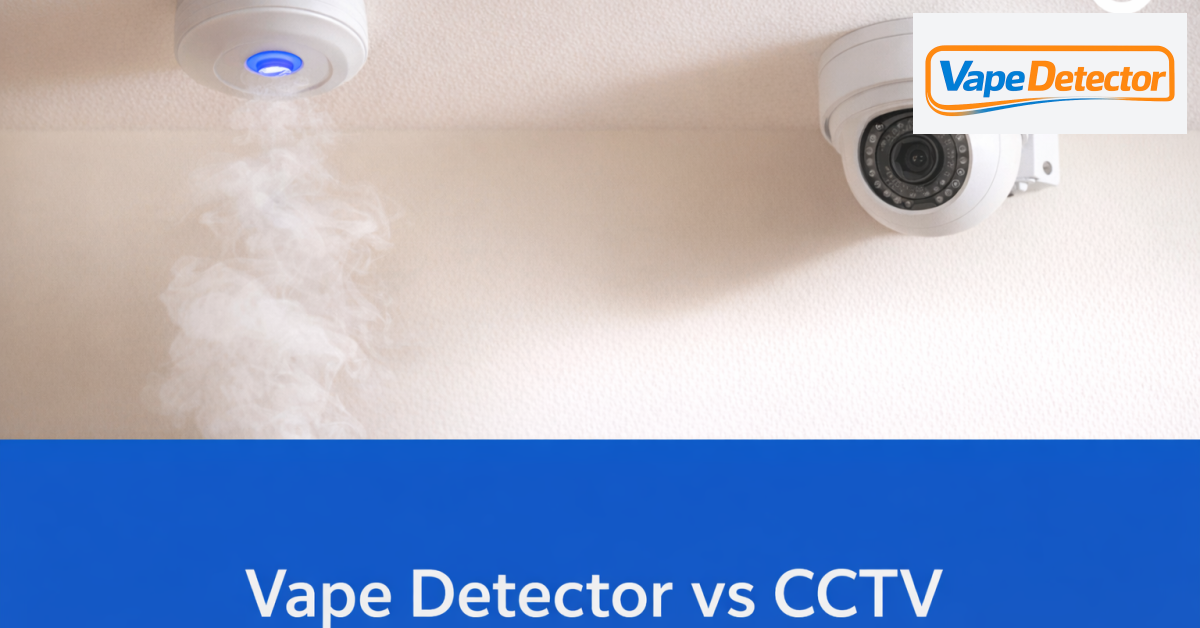
Vape Detector vs CCTV
Vape detectors and CCTV solve different parts of the same problem. Vape detectors identify airborne indicators linked to vaping and send alerts, while CCTV captures visual footage that supports review and investigation. The right choice depends on where incidents happen, how quickly staff need to respond, and what level of privacy protection the site requires.
Many UK sites also face constraints that shape the decision. Toilets and changing areas often prohibit cameras, while schools, workplaces, and public buildings require clear policies and data protection controls for any monitoring. Comparing detection, evidence, speed, cost, and compliance helps organisations select a proportionate approach.
What Each System Detects And Records
Vape detectors and CCTV differ most in what they sense and what they store. Vape detectors focus on detecting the presence of vaping-related aerosol in the air, while CCTV focuses on recording visual activity within a camera’s field of view. UK decision-making often comes down to whether the priority is rapid detection in privacy-sensitive areas, or visual evidence for identification and follow-up.
Both systems also create different “records”. Vape detectors typically create event logs and alerts, while CCTV creates video files that require careful storage, access control, and retention decisions.
What A Vape Detector Detects
A vape detector detects changes in air composition consistent with vaping aerosol, using sensors designed for particulate and or chemical indicators depending on the model. Vape detectors typically generate an alert when measured values pass a configured threshold for a set time period.
Vape detectors usually record an event log rather than recording people. Event logs often include the date and time of the alert, detector identity, and alert type. Some devices also provide environmental readings to support troubleshooting and threshold tuning, subject to the product’s design.
What CCTV Detects
CCTV detects and records visual scenes within the camera’s coverage area. CCTV footage shows actions, movement, clothing, and in some cases faces, subject to resolution, angle, lighting, and compression settings.
CCTV does not directly sense vaping aerosol. CCTV relies on visible cues such as hand-to-mouth movement, vapour plumes, device shape, and contextual behaviour. CCTV evidence depends on whether the behaviour is visible and whether footage quality supports identification.
Detection Vs Evidence Capture
Vape detectors prioritise detection. CCTV prioritises evidence capture. A vape detector alert supports intervention when staff act quickly, while CCTV footage supports after-the-fact review, disciplinary processes, or incident reporting when identification matters.
A UK site often needs to separate two questions. The first question is “how does staff learn vaping happens in a specific location?” The second question is “what evidence supports a proportionate response under site policy and data protection rules?”
Vape detectors and CCTV answer those questions in different ways, so the comparison works best when each system is evaluated against the specific operational need.
Vape detectors and CCTV solve different parts of the same problem. Vape detectors identify airborne indicators linked to vaping and send alerts, while CCTV captures visual footage that supports review and investigation.
Speed Of Response And Real-Time Alerts
Speed matters when the aim is to stop behaviour during the incident, reduce safeguarding risks, or prevent escalation into vandalism or disorder. Vape detectors usually deliver direct alerts to nominated staff, while CCTV response depends on whether someone watches live feeds or reviews footage later. UK sites often prefer predictable alerting because toilets, stairwells, and corridors rarely receive continuous monitoring.
Response speed also depends on workflow. An effective workflow includes who receives alerts, how alerts are verified, and what staff do next in line with safeguarding and behavioural policies.
Vape Detector Alert Workflows
Vape detector alert workflows typically follow a detect-to-notify model. The detector triggers an alert, and the alert reaches staff through a configured channel such as a local sounder, a panel, or network notifications, depending on the installation.
Vape detector workflows usually include a verification step. Staff verify location and context, then apply site policy, such as attending the area, logging the incident, and escalating safeguarding concerns when required. A practical workflow also addresses repeated alerts at the same time of day, which often indicates a supervision gap rather than a sensor fault.
CCTV Monitoring And Review Workflows
CCTV monitoring workflows depend on whether the site uses live monitoring. Live monitoring provides faster intervention but requires staffing, defined responsibilities, and clear lawful basis and policies. Many sites rely on review workflows instead, where an incident report triggers a search of recorded footage.
CCTV review workflows typically include time-window selection, camera selection, playback, and export controls. Evidence handling also requires secure storage and access control because CCTV footage often counts as personal data under UK data protection rules.
Typical Delay Points In Each Approach
Vape detector delays often come from thresholds and confirmation windows. Some devices use a short time period to reduce false alarms, which adds seconds before an alert triggers. Delays also occur when alert routing is unclear, such as sending notifications to an unattended inbox or a phone that staff do not carry.
CCTV delays often come from staffing and discoverability. An incident that is not noticed during the event requires someone to report it. Review then takes time to locate the relevant camera and timeframe, and footage quality may not support a clear conclusion.
Response speed improves when each approach matches the operating model, including staffing levels, incident frequency, and the site’s supervision patterns.
Accuracy, Blind Spots, And False Alarms
Accuracy depends on environment and configuration. Vape detectors have sensor-related limitations, while CCTV has coverage and visibility limitations. UK sites usually reduce risk by identifying blind spots early and setting realistic expectations about what each system confirms.
False alarms create operational costs and erode trust in alerts. Managing false alarms requires both technical tuning and clear policies for how staff respond to alerts.
Vape Detector Sensitivity And Environmental Factors
Vape detector sensitivity varies by detector type, sensor design, and configuration. Environmental factors influence readings, including airflow, room volume, extraction fans, open doors, and the presence of aerosols from other sources.
Toilets often present a mixed environment. High humidity, deodorant sprays, and strong airflow from hand dryers or ventilation can affect detection patterns. Placement and commissioning reduce these effects by matching sensor location to expected airflow and by tuning thresholds to the site’s baseline conditions.
CCTV Coverage Limits And Occlusion
CCTV coverage depends on line of sight. Camera angle, mounting height, lighting, and obstructions determine what the camera captures. Toilets, cubicles, and changing areas often restrict camera use entirely, which creates unavoidable blind spots.
Occlusion also affects non-private spaces. Hoodies, crowding, door frames, and poor lighting reduce the chance of capturing a clear vaping event. Even when vaping occurs in view, vapour may not appear clearly due to lighting and camera compression.
Common False Alarm Triggers And How To Reduce Them
Common vape detector false alarm triggers include aerosol sprays, steam, and dust. Some sites also see alerts linked to cleaning routines, deodoriser use, or high humidity. False alarms reduce when commissioning includes baseline measurement and threshold tuning, and when cleaning products and routines are reviewed for compatibility with sensor behaviour.
Common CCTV “false positives” include gestures that resemble vaping, such as eating, drinking, or using inhalers, and any activity partially obscured by crowds or doorways. Misinterpretation reduces when operators use time context and multiple camera angles where available, and when sites avoid treating a single ambiguous clip as conclusive evidence.
Accuracy improves when vape detectors handle detection in privacy-sensitive areas and CCTV handles corroboration in suitable spaces, with clear expectations for each system.
Privacy, Compliance, And Acceptable Use In UK Settings
Privacy and compliance often drive the decision more than technology. CCTV use in the UK requires careful attention to lawful basis, transparency, access controls, and retention. Vape detectors generally raise fewer privacy issues because they do not identify individuals, but acceptable use still matters, especially around placement, alert handling, and any optional features.
UK settings such as schools, colleges, workplaces, and leisure venues often need a documented rationale. The rationale explains why monitoring is necessary, how it remains proportionate, and how staff handle data and incidents.
CCTV Data Protection And Signage Requirements
CCTV footage usually constitutes personal data because it can identify people. UK sites typically need clear signage that explains CCTV use and a documented approach to data protection compliance, including access restrictions and retention periods aligned to purpose.
CCTV operation also requires governance over who reviews footage, who exports clips, and how exports are stored and shared. Governance reduces the risk of unauthorised viewing, informal sharing, and extended retention without justification.
Vape Detector Privacy Considerations
Vape detectors usually do not capture identifiable personal data because they sense air quality indicators rather than recording images or sound. That difference makes vape detectors more suitable for toilets and other privacy-sensitive areas where cameras are inappropriate.
Vape detector privacy still depends on how alerts are handled. Alert logs and incident records can become sensitive when they link to named individuals, safeguarding notes, or disciplinary processes. A clear policy controls who receives alerts, how incidents are recorded, and how long logs are kept.
Audio Recording And Higher-Risk Compliance Issues
Audio recording often increases compliance risk because conversations are highly sensitive and context-dependent. UK sites usually treat audio as higher-risk than video because it captures content rather than activity alone.
Many CCTV installations avoid audio recording entirely. Any system that records audio requires especially careful justification, transparency, and strict access control. Vape detectors that include microphones or sound analysis features also require careful review of privacy impact and acceptable use, particularly in education and workplace settings.
Compliance improves when monitoring is limited to what is necessary for safety and policy enforcement, with clear documentation and staff training.
Installation, Coverage, And Ongoing Maintenance
Installation and maintenance shape real-world performance. Vape detectors need correct placement and commissioning to match airflow patterns. CCTV needs careful camera placement, lighting consideration, and a storage plan that supports the intended retention and evidence needs. UK sites often underestimate the ongoing work, such as cleaning lenses, testing alerts, and managing storage.
A maintainable system includes routine health checks and a clear process for faults. That process reduces downtime and prevents “silent failures” where staff assume coverage exists when it does not.
Vape Detector Placement And Commissioning
Vape detector placement follows airflow and typical usage patterns. Toilets, corridors, stairwells, and changing areas each behave differently. Commissioning typically includes functional testing, alert routing tests, and threshold tuning against the site’s baseline environment.
Commissioning also includes operational setup. Named recipients, escalation paths, and quiet-hours rules reduce missed alerts and reduce unnecessary disruption during times when response is not possible.
CCTV Camera Placement, Lighting, And Storage
CCTV camera placement focuses on covering entry points, corridors, and known hotspots without intruding into private areas. Lighting affects footage quality, especially at night or in poorly lit stairwells. Camera selection and configuration also influence whether footage supports identification.
CCTV storage requires a defined retention period, secure access control, and reliable export capability. Storage sizing depends on camera count, resolution, frame rate, compression settings, and recording mode, such as continuous or motion-based recording.
Cleaning, Calibration, Firmware, And Health Checks
Vape detector maintenance often includes routine cleaning of vents, periodic calibration where applicable, and verification tests of alert delivery. Firmware updates matter when they address sensor stability, network security, or integration changes.
CCTV maintenance includes cleaning lenses, checking focus, verifying time synchronisation, and testing recording and playback. Health checks also cover network connectivity and storage status to avoid gaps in footage.
A consistent maintenance routine reduces false alarms, missed incidents, and avoidable call-outs.
Costs And Total Cost Of Ownership
Total cost of ownership includes more than purchase price. Hardware, installation, subscriptions, storage, and staffing each affect cost over time. UK organisations usually achieve better value by matching capabilities to the specific risk, rather than paying for unused features.
Cost evaluation also benefits from clarity on the purpose. A system designed for rapid intervention has different operating costs from a system designed mainly for post-incident evidence.
Hardware And Installation Costs
Vape detector hardware costs depend on sensor type, network requirements, and any local sounders or panels. Installation cost depends on power availability, mounting constraints, and whether cabling or network configuration is required.
CCTV hardware costs depend on camera count, camera specification, mounting hardware, and the recording system. Installation cost depends on cable runs, network switches, power over ethernet needs, and any building constraints for fixing and concealment.
Software, Storage, And Subscription Costs
Vape detector subscriptions often relate to cloud dashboards, alert routing, and device management. Costs also depend on integration features, reporting, and multi-site oversight requirements.
CCTV software costs depend on video management licensing and any analytics features. Storage costs depend on retention requirements, recording settings, and whether storage is on-site or cloud-based, with additional costs for retrieval and export in some setups.
Staffing And Operating Costs
Vape detector operating costs centre on responding to alerts and managing incident logs. A high alert rate increases staff time, especially if thresholds are too sensitive or if environmental triggers are common.
CCTV operating costs rise when live monitoring is required. Review-only models still require staff time for footage retrieval, incident documentation, and handling subject access requests where applicable.
A realistic total cost assessment treats staff time as a core component, not an afterthought.
Best-Fit Use Cases By Site Type
Different site types face different constraints. Schools and colleges often need rapid intervention in toilets and safeguarding-sensitive areas. Workplaces often prioritise policy enforcement and health and safety. Hospitality and transport settings often prioritise public safety, vandalism reduction, and incident investigation. UK decision-making improves when each site maps hotspots and selects monitoring that fits each space.
Some sites also need different approaches within the same building. A corridor may suit CCTV, while toilets may only suit non-visual detection.
Schools And Colleges
Schools and colleges often use vape detectors to address vaping in toilets and secluded areas where supervision is limited and cameras are inappropriate. Fast alerts support timely staff intervention and safeguarding responses.
CCTV in schools and colleges often focuses on corridors, entrances, and communal areas. CCTV footage supports investigation of repeated incidents, unauthorised visitors, and vandalism linked to vaping hotspots.
Toilets, Changing Rooms, And Private Areas
Toilets and changing rooms usually rule out CCTV because of privacy expectations and compliance risk. Vape detectors fit these areas because detection does not require capturing images of people.
Policy clarity remains essential in private areas. Staff response procedures need to protect dignity while still enforcing behaviour standards, especially when safeguarding risks exist.
Workplaces And Public Buildings
Workplaces and public buildings often use a mix. Vape detectors support detection in toilets and stairwells, while CCTV supports coverage of entrances, exits, and shared spaces.
Workplace compliance also depends on clear staff communications and purpose limitation. Monitoring needs a defined rationale and consistent enforcement to avoid selective or unfair application.
Hospitality, Retail, And Transport
Hospitality, retail, and transport settings often use CCTV for incident evidence and deterrence in public-facing areas. Footage supports investigations into disputes, theft, and damage linked to smoking or vaping breaches.
Vape detectors may suit toilets, staff areas, or other spaces where vaping breaches are common but cameras are unsuitable. Response workflow matters in these settings because staff availability varies by time of day and peak periods.
Best fit comes from matching the system to each zone’s privacy profile and operational response capacity.
Using Vape Detectors And CCTV Together
Combined use often works best because each system covers the other’s weaknesses. Vape detectors provide rapid detection in privacy-sensitive or poorly supervised areas, while CCTV provides visual context in permitted spaces. UK sites that combine both typically need clear evidence handling rules to avoid over-collection and to keep responses proportionate.
Integration also affects incident management. Alerts and footage need consistent time settings and clear handover steps so staff can act quickly and document outcomes.
Layered Detection And Evidence Handling
Layered detection uses vape detectors to trigger attention and CCTV to provide context where cameras are allowed. A common approach uses vape detector alerts to prompt staff to check nearby corridors covered by CCTV, rather than trying to identify people inside private spaces.
Evidence handling needs consistency. Incident logs should record time, location, staff actions, and outcomes, while CCTV footage export should follow access control and retention rules that align to the stated purpose.
Incident Response Policy And Escalation Paths
Incident response policy defines what happens after an alert or observed behaviour. Policy often includes verification steps, safeguarding considerations, and proportionate interventions, especially in schools and youth settings.
Escalation paths define who receives alerts first, who attends the location, and who handles repeat offenders or safeguarding concerns. Clear escalation reduces missed alerts and prevents inappropriate confrontations in private areas.
Integration With Access Control And Fire Alarm Policies
Access control integration may support investigation by confirming who entered a corridor or staff-only area at a time linked to an alert, where such processing is justified and documented. Access data also raises additional privacy considerations, so purpose limitation and access controls remain important.
Fire alarm policy integration needs caution. Vape detectors do not automatically equate to fire detection. Any linkage to fire alarm systems requires competent design and clear separation between vaping alerts and fire safety signals, so false activations do not undermine fire safety procedures.
A combined approach works best when each system has a clearly defined role in detection, response, and record-keeping.
Buying Checklist For Vape Detectors And CCTV
Buying decisions depend on the site’s risk profile, privacy constraints, and response capacity. Specifications matter, but operational fit matters more because detection without response rarely changes outcomes. UK purchasers also need clarity on data handling, retention, and who has access to alerts and footage.
A checklist helps compare like-for-like and avoids gaps that only appear after installation, such as weak alert routing or unusable footage in low light.
Questions To Ask Vendors And Installers
- What does the vape detector measure, and what triggers an alert?
- What alert channels does the system support, and how are recipients configured?
- What testing process confirms end-to-end alert delivery during commissioning?
- What environmental conditions commonly cause false alarms in similar sites?
- What maintenance tasks are required, and what is the recommended schedule?
- What CCTV resolution, frame rate, and low-light performance match the site’s lighting?
- What storage configuration meets the required retention period at the chosen settings?
- What controls restrict who views, exports, and shares CCTV footage?
- What documentation supports UK data protection compliance, including signage and retention?
- What integration options exist for existing security systems, and what are the constraints?
Clear answers reduce mismatched expectations and support a defensible procurement decision. Vendor responses also indicate whether long-term support and maintenance are realistic.
Specifications That Affect Performance
- Sensor type and detection thresholds for vape detectors, including any configurable confirmation time
- Network connectivity options, including whether offline alerting exists if the network fails
- Event logging detail, including timestamps and detector identifiers
- Camera field of view, resolution, and low-light capability for CCTV
- Recording settings, including continuous versus motion-based recording and time synchronisation
- Storage resilience, including overwrite behaviour and failure alerts
- Access control features for both systems, including role-based permissions where available
- Firmware update process and security support expectations
Specifications only translate into performance when commissioning matches the site environment. A specification review also needs a plan for testing under real conditions.
Policies That Reduce Risk And Improve Outcomes
- Alert handling rules that define who responds, how quickly, and what verification steps apply
- Privacy rules that restrict CCTV coverage away from private areas and limit access to footage
- Incident logging rules that separate factual observations from assumptions
- Retention rules for CCTV footage and incident records that align to purpose
- Training for staff who receive alerts or review footage, including safeguarding and escalation
- Maintenance rules that define routine checks, fault reporting, and service ownership
Policies reduce both operational risk and compliance risk. Policy clarity also makes outcomes more consistent across staff teams and shifts.
FAQs
Are Vape Detectors Legal In UK Toilets?
Vape detectors are generally suitable for UK toilets because vape detectors do not record images of people. Legality depends on how the site uses the system, how alerts are handled, and whether processing of any related personal data remains necessary and proportionate.
A site policy that explains purpose, access to logs, and incident recording practices supports acceptable use in privacy-sensitive areas.
Does CCTV Detect Vaping Reliably?
CCTV does not detect vaping directly. CCTV records visual scenes and relies on visible cues that are often ambiguous, especially in poor lighting or crowded areas.
CCTV reliability improves when cameras cover entrances and corridors near hotspots and when footage quality supports clear identification, but vaping inside toilets and cubicles remains outside acceptable camera coverage.
Do Vape Detectors Record Audio Or Video?
Most vape detectors focus on sensor readings and event logs rather than audio or video recording. Feature sets vary by product, so procurement needs a clear confirmation of what data the device captures and stores.
Any audio feature requires careful review because audio data increases privacy risk and compliance complexity.
Which Option Works Better For Preventing Vaping In Schools?
Vape detectors usually provide stronger coverage for school vaping hotspots such as toilets because they enable timely staff response without using cameras in private areas. CCTV supports prevention indirectly by covering corridors and entrances and by supporting investigation of repeated incidents.
A combined approach often matches school needs when policies clearly define response steps, safeguarding escalation, and evidence handling.
Can Vape Detectors Trigger Fire Alarms?
Vape detectors are not fire detectors. Some installations integrate alerts into wider building systems, but any connection to fire alarm infrastructure requires careful design to prevent false activations and confusion between vaping incidents and fire events.
Fire safety responsibility remains separate from behaviour monitoring, and procedures need to reflect that separation.
Conclusion
Vape detectors and CCTV address different needs. Vape detectors provide rapid detection of vaping-related aerosol, which suits toilets and other privacy-sensitive areas. CCTV provides visual evidence in permitted areas, but CCTV does not directly sense vaping and often depends on interpretation of behaviour.
A proportionate UK approach matches each system to the right locations, supports a clear response workflow, and applies data protection controls that fit the sensitivity of the setting. Combining vape detectors with CCTV often delivers the most complete coverage when roles, policies, and evidence handling rules remain clearly defined.