
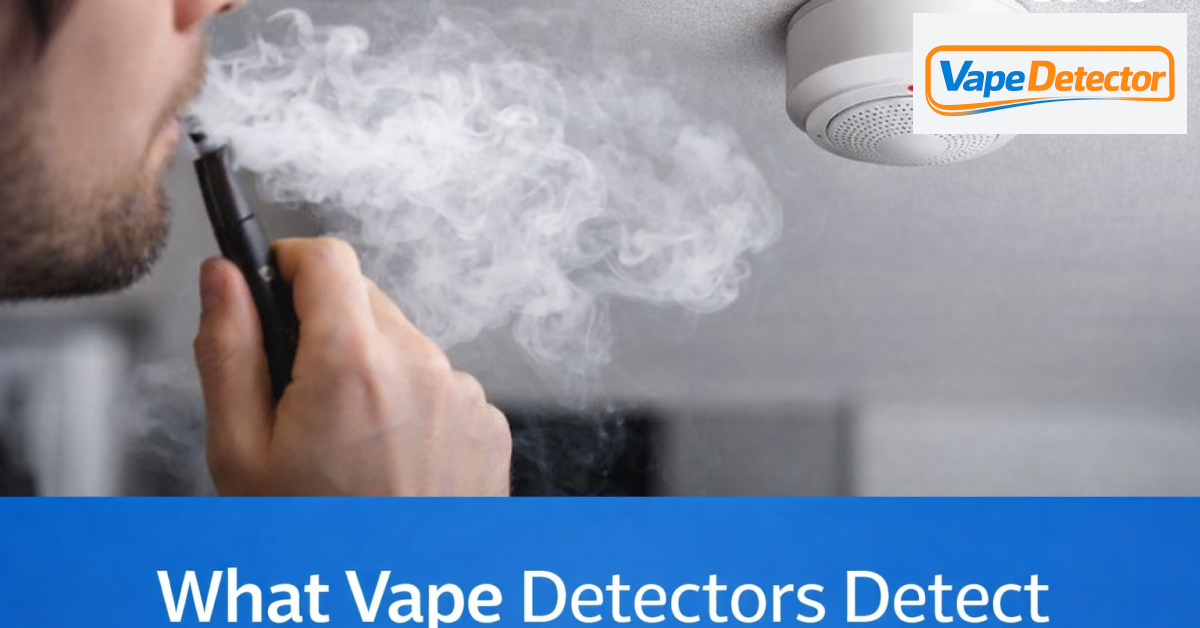
What Vape Detectors Detect
Vape detectors detect changes in air that match the release of vaping aerosol. Most systems use a mix of particle sensing and gas sensing to identify patterns linked to e-cigarette use rather than a single substance.
Detection depends on what enters the air, how it moves around the room, and how the detector thresholds are configured. Results usually indicate “aerosol event detected” rather than proving which device was used or who used it.
Aerosols And Vapour Particles
Vaping produces an aerosol made of tiny liquid droplets and gases. Vape detectors often focus on these droplets because they behave differently from normal indoor dust and from combustion smoke, especially immediately after an exhale.
Aerosol detection matters in UK settings such as schools, toilets, and workplaces because vaping often happens in enclosed spaces with limited ventilation. Detector performance changes with airflow, distance, and competing airborne products such as sprays.
What Counts As Vaping Aerosol
Vaping aerosol is the mixture released when an e-liquid is heated and then condenses into droplets in cooler air. The aerosol typically includes propylene glycol, vegetable glycerine, nicotine or nicotine salts, flavour compounds, and trace by-products.
Vape detectors generally treat any concentrated burst of fine droplets with a “vaping-like” profile as a candidate event. The detector logic often looks for a rapid rise, a peak, and then a decay pattern that fits exhaled aerosol dispersal.
Particle Size And Why It Matters For Detection
Particle size matters because different sensors respond to different size ranges. Many detectors use optical particle sensors that react strongly to fine aerosols, while larger particles settle faster and behave more like dust.
Vaping aerosol often contains a large number of fine droplets that remain suspended long enough to drift to a ceiling-mounted sensor. The same room conditions can reduce detection if the aerosol disperses sideways into extraction vents before reaching the unit.
Visible Vapour Vs “Stealth” Aerosol
Visible vapour usually indicates a higher concentration of droplets, which increases detection likelihood. “Stealth” aerosol occurs when lower power settings, tighter airflow, or different e-liquid ratios produce less visible exhale.
“Stealth” aerosol still changes indoor air, but the signal may sit closer to background levels. Sensitivity settings and placement become more important when visible plumes are minimal.
Chemical Signatures Vape Detectors Respond To
Some vape detectors include gas sensors that respond to chemical families associated with vaping. The response usually reflects a pattern of volatile compounds rather than a definitive identification of a named ingredient.
Chemical sensing matters because particle-only detection can miss low-visibility aerosols or confuse some non-vaping aerosols. Combining particle and gas inputs often improves discrimination but does not eliminate false positives.
Because flavourings can shift VOC patterns and sensor responses, it helps to understand flavoured vapour and additives in the context of what detectors are actually measuring.
Nicotine And Nicotine Salts
Nicotine is a target compound in many e-liquids, but nicotine is not easy to measure directly with common low-cost sensors used for indoor monitoring. Many detectors do not “detect nicotine” in the way a laboratory instrument does.
Nicotine salts change how nicotine is formulated and inhaled, but the aerosol still contains a mix of solvents and flavour chemicals. Detectors typically respond to the overall aerosol event rather than proving nicotine presence.
For a deeper look at how sensors interpret nicotine-related plumes in real rooms, see nicotine vape aerosol detection.
Propylene Glycol And Vegetable Glycerine
Propylene glycol and vegetable glycerine form the bulk of most e-liquids. These solvents readily create fine droplets when heated and then cooled in room air.
Optical sensors often detect the resulting droplet cloud as a spike in particulate concentration. Gas sensors may also respond to solvent-related vapours, depending on sensor type and calibration.
Flavour Compounds And Volatile Organic Compounds (VOCs)
Flavourings contribute a wide range of volatile organic compounds. Some detectors include VOC sensors that react to increases in these compounds, particularly when they rise sharply over a short period.
A VOC signal alone rarely proves vaping because many everyday products emit VOCs. Stronger detection usually comes from a combined pattern: VOC change alongside a particle spike and a decay curve consistent with an exhale event.
Carbonyls And Other By-Products
Heating e-liquids can generate trace by-products, including carbonyl compounds, depending on device settings and conditions. Typical indoor sensors do not measure specific carbonyls accurately at low levels.
Some detectors may respond indirectly to by-product mixtures as part of a general VOC response. The presence of by-products is not usually separable from other VOC sources without specialist sampling.
Gases And Air Quality Changes
Vaping affects indoor air beyond particles, including VOC levels and sometimes humidity and temperature in the exhaled plume. Vape detectors may use these secondary signals to strengthen or confirm a suspected event.
Gas and air quality signals matter for rooms with airflow patterns that dilute particles quickly. A combined approach helps distinguish short, localised exhale events from slower background changes.
VOC Spikes And Off-Gassing Signals
A vaping exhale often produces a fast VOC spike followed by a decline as the plume disperses. Some detectors identify this “spike and decay” behaviour as more consistent with vaping than with slow off-gassing from furniture or building materials.
Off-gassing signals usually change gradually. A detector that logs rates of change can treat rapid increases as higher risk events when supported by particle data.
Humidity And Temperature Shifts
Exhaled breath is warm and humid, and vaping aerosol carries additional moisture-like behaviour because the plume contains many fine droplets. A detector with humidity and temperature sensors may use short, localised shifts as supporting evidence.
Humidity and temperature changes alone do not confirm vaping. Showers, hand dryers, and poor ventilation can create similar patterns, especially in toilets and changing rooms.
Carbon Monoxide And Why It Usually Does Not Indicate Vaping
Carbon monoxide is primarily associated with combustion. Vaping does not involve burning tobacco, so carbon monoxide does not usually rise during normal e-cigarette use.
A carbon monoxide alarm activation typically indicates a separate risk source such as a faulty boiler, vehicle exhaust ingress, or other combustion. Vape detectors and carbon monoxide alarms serve different safety purposes even when installed in the same building.
Cannabis And THC Vape Detection
Some vape detectors claim cannabis or THC vape detection, usually by looking for chemical patterns that differ from nicotine e-liquids. Performance depends heavily on sensor type, airflow, and the variability of cannabis products.
Cannabis detection claims matter because schools and workplaces often need clarity on what an alert means. Many systems indicate a “likely vape event” with optional “possible cannabis-related VOC profile” rather than a definitive THC identification.
Because most systems infer cannabis use from VOC patterns rather than identifying a specific molecule, it helps to understand how thc vape aerosol detection is typically described and what its limits are.
THC Oil Aerosols Vs Nicotine E-Liquids
THC oils and distillates often aerosolise differently from propylene glycol and vegetable glycerine blends. The droplet composition, volatility, and odour profile can shift the sensor response.
Some detectors attempt to separate profiles using VOC patterns and event shape. The overlap between products remains significant because flavourings, terpenes, and solvents vary widely.
Terpenes And Other Marker Compounds
Terpenes are aromatic compounds common in cannabis products and some flavourings. A VOC sensor can react to terpene-rich plumes, but it usually cannot identify a specific terpene without laboratory-grade analysis.
Marker compounds are also not exclusive to cannabis. Some cleaning agents, fragrances, and flavour aerosols share chemical families that produce similar sensor responses.
Limits Of “THC Detection” Claims
Most commercial indoor detectors do not provide forensic identification of THC. Many sensors measure total VOC response rather than specific molecules, which limits certainty.
A “THC detected” label often reflects a classification model trained on certain product profiles. Changes in product formulation, airflow, and background VOCs can reduce reliability, so alerts are better treated as indicators for investigation rather than proof.
Smoke, Combustion, And Fire-Related Detection
Vape aerosol differs from smoke because vaping produces droplets without combustion. Some systems detect both aerosols and smoke-like particles, but the detection goals differ from fire safety detection.
Understanding the difference matters because a vape detector alert is not a fire alarm signal. Buildings still need compliant smoke and heat detection for fire protection.
Cigarette And Tobacco Smoke
Cigarette smoke contains combustion particles and gases produced by burning tobacco and paper. The particle profile often includes very fine particles that linger, plus characteristic gases from combustion.
Some vape detectors respond to cigarette smoke because the particulate load is high. Other systems treat smoke as a separate class or ignore it to reduce nuisance alerts where smoking occurs outdoors near entrances.
Because sensors respond differently to combustion particles and liquid aerosol droplets, reviewing smoke vs vapour differences for detection can help clarify why vape alerts and smoke alarms are not interchangeable.
Combustion Particles Vs Vape Aerosol
Combustion produces solid particles and soot-like material, while vaping produces mostly liquid droplets that evaporate or deposit differently over time. This difference influences how long the signal persists and how it spreads in a room.
Detectors that combine particle characteristics with VOC patterns often separate a vaping event from a smoke event more effectively than a single-sensor device.
How Vape Detectors Relate To Smoke Alarms
Smoke alarms are designed for early fire detection and follow fire safety standards and building regulations. Vape detectors are designed for policy compliance and behaviour monitoring rather than life safety.
A vape detector does not replace a smoke alarm. A smoke alarm does not reliably detect vaping because it is tuned to fire-related particle behaviour and alarm thresholds.
What Vape Detectors Do Not Detect
Vape detectors primarily detect airborne emissions, not the mere presence of a device or nicotine in someone’s system. Limits matter for settings that need clear expectations about what triggers an alert.
Non-detection scenarios are common when no aerosol reaches the sensor or when the aerosol signal blends into background air quality changes. Understanding the gaps reduces misinterpretation of alerts.
Vapes Present But Not Used
A vape stored in a room does not release enough aerosol to trigger detection under normal conditions. Detectors do not identify devices by Bluetooth, serial number, or location unless a separate tracking system exists.
A device that leaks e-liquid may create odour or residue, but that does not automatically generate a detectable airborne aerosol event.
Devices In Bags, Pockets, Or Drawers
Aerosol trapped in a bag or drawer usually disperses slowly and dilutes quickly once released. The resulting signal often stays below alert thresholds, especially in ventilated rooms.
Accidental firing inside a pocket can release aerosol, but the person’s clothing and movement often disrupt the plume in unpredictable ways, which affects detection consistency.
Nicotine In Breath Without Aerosol
Nicotine absorbed into the body does not create a measurable “nicotine breath” signal for typical vape detectors. Breath odour or residual smell is not the same as an airborne aerosol plume.
Detectors respond to particulate and VOC changes in room air, not to biological nicotine presence.
Edibles And Non-Inhaled Products
Edibles, patches, and oral nicotine products do not generate vaping aerosol. Detectors do not respond unless another airborne product causes particle or VOC changes.
Non-inhaled cannabis products also sit outside the scope of vape aerosol detection.
Factors That Affect Detection Accuracy
Detection accuracy depends on installation, airflow, room geometry, and background air contaminants. These factors shape whether aerosol reaches the sensor at a concentration that crosses the alert threshold.
Accuracy matters for UK environments with variable ventilation, such as toilets with extractor fans, corridors with drafts, and classrooms with open windows. A consistent approach to placement and settings reduces nuisance alerts and missed events.
Distance, Airflow, And Ventilation
Distance reduces concentration because the plume disperses as it travels. Strong ventilation can either help or hinder detection depending on whether airflow carries aerosol towards the unit or extracts it before it reaches the sensor.
Key practical checks for airflow effects include:
- Extractor fans pulling air directly away from the detector location
- Open windows creating cross-drafts that bypass ceiling sensors
- Door gaps channelling plumes into corridors rather than upwards
Airflow assessment links directly to whether a detector records repeatable events in the same room.
Room Size, Ceiling Height, And Placement
Large rooms dilute aerosol faster than small rooms. High ceilings increase the time and mixing needed for a plume to reach a ceiling-mounted unit.
Placement near likely use areas and within predictable air paths improves performance. Placement decisions also affect privacy expectations in sensitive areas such as toilets and changing rooms.
Background Aerosols From Cleaning Sprays, Deodorants, And Fog Machines
Cleaning sprays and deodorants produce aerosols and VOCs that sometimes resemble vaping patterns, especially when applied in short bursts. Fog machines produce dense aerosol that can overwhelm particle sensors.
Common warning signs for background-triggered alerts include:
- Alerts coinciding with scheduled cleaning times
- Multiple alerts across adjacent rooms during corridor spraying
- Alerts during performances or events using haze or fog effects
Background source control and threshold tuning reduce false alerts without removing detection capability.
Time To Detect And Reset Behaviour
Time to detect varies with sensor sampling rate, plume travel time, and thresholds. Some systems alert within seconds of a nearby exhale, while others require longer averaging to reduce nuisance triggers.
Reset behaviour also varies. A room with poor ventilation can hold elevated particle or VOC levels longer, which delays return to baseline and affects repeated alert patterns.
Alerts, Thresholds, And Evidence Quality
An alert represents a sensor-based classification that air conditions match a configured event type. Evidence quality depends on whether the system logs supporting data such as timestamps, sensor readings, and device status.
Evidence interpretation matters in schools and workplaces because alerts often trigger safeguarding or disciplinary processes. A clear policy on what an alert does and does not prove reduces unfair outcomes.
What An Alert Typically Represents
Most alerts indicate that a threshold was exceeded for particles, VOCs, or a combined score. Some systems categorise the event as “vape”, “smoke”, or “air quality” depending on configured rules.
An alert rarely identifies a person. An alert indicates that aerosol-like emissions occurred within the effective sensing zone during the logged time window.
Threshold Settings And Sensitivity Trade-Offs
Higher sensitivity increases detection of low-output or “stealth” vaping but also increases nuisance triggers from sprays and other aerosols. Lower sensitivity reduces nuisance triggers but increases missed events, particularly in large or ventilated spaces.
Settings also interact with placement. A detector near an extractor outlet often needs different thresholds from a detector in a stagnant corner.
Data Logging And Audit Trails
Data logging supports review by recording time, duration, sensor values, and device health information. An audit trail helps distinguish a single spike from repeated events and helps identify environmental causes such as cleaning schedules.
Logged data quality varies by manufacturer and configuration. Some systems store only alert events, while others store continuous air quality readings.
Privacy Considerations In Schools And Workplaces
Privacy depends on what data the system collects and how it is used. Many vape detectors do not include cameras or audio recording, but policies still need to cover location, access controls, retention periods, and disclosure.
Schools and employers often align use with safeguarding, health and safety, and proportionate monitoring expectations. Clear signage and documented purpose reduce misunderstandings about surveillance.
FAQs
Do Vape Detectors Detect Nicotine Specifically?
Most vape detectors do not measure nicotine as a distinct chemical in the way a laboratory test does. Vape detector basics explain that vape detectors detect patterns in particles and VOCs that often accompany nicotine e-liquid aerosol.
Nicotine-free vapes can still trigger alerts because propylene glycol, vegetable glycerine, and flavour aerosols still change particle and VOC levels.
Do Vape Detectors Detect THC Vapes?
Some vape detectors classify events as potentially consistent with cannabis vaping based on VOC patterns. Most systems do not provide definitive THC identification.
THC vape detection performance varies with product composition, ventilation, and background VOC sources such as fragrances and cleaning products.
Can Perfume Or Deodorant Trigger A Vape Detector?
Perfume and deodorant sprays can trigger vape detectors because they create aerosols and VOC spikes. The risk is higher when sprays are used close to the detector or in a small room.
Sensitivity tuning and placement away from routine spraying points reduce nuisance alerts, but they do not remove the possibility entirely.
Do Vape Detectors Work In Toilets And Changing Rooms?
Toilets and changing rooms often produce detectable events because they are enclosed and commonly used for concealed vaping. Extractor fans can also remove aerosol quickly, which reduces detection if airflow pulls plumes away from the sensor.
Placement that matches airflow patterns and avoids direct fan extraction paths improves consistency.
Do Vape Detectors Detect Cigarette Smoke?
Some vape detectors detect cigarette smoke because smoke creates strong particle signals and VOC changes. Other systems focus on vaping and treat smoke as a separate category or lower priority to reduce nuisance alerts.
Fire safety still relies on compliant smoke and heat alarms rather than vape detectors.
How Far Away Can A Vape Detector Detect Vapour?
Range depends on room size, ceiling height, ventilation, and the strength of the aerosol event. A strong exhale in a small, poorly ventilated room travels further than a low-output exhale in a ventilated space.
Manufacturer specifications vary and often assume specific installation conditions, so real-world range needs site testing and review of logged events.
Conclusion
Vape detectors detect airborne aerosol events and related changes in particles and VOCs. Detection usually reflects a pattern consistent with vaping rather than a single ingredient such as nicotine or THC.
Accuracy depends on airflow, placement, thresholds, and background aerosols from everyday products. Clear interpretation of alerts and good installation practice provide more reliable outcomes in schools and workplaces.