
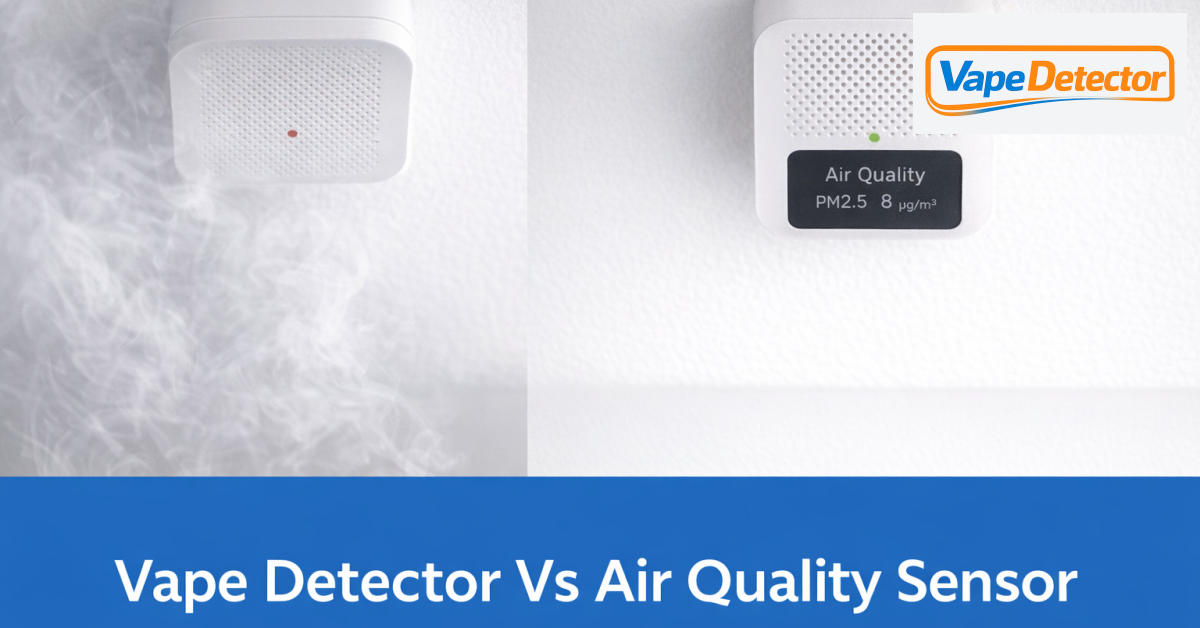
Vape Detector Vs Air Quality Sensor
Vape detectors and air quality sensors both measure what is in the air, but they serve different operational goals. Vape detectors focus on identifying vaping events and raising timely alerts in specific risk areas. Air quality sensors focus on broader indoor environment monitoring and longer-term optimisation. Choosing the right device affects alert reliability, privacy compliance, integration with site systems, and total running cost across UK sites.
Key Differences At A Glance
Vape detectors prioritise event detection and rapid notification, usually for safeguarding, policy enforcement, and incident response. Air quality sensors prioritise measurement of indoor air parameters for health, comfort, and building performance, with reporting that often suits facilities management.
- Vape detector: detects aerosol patterns linked to vaping and triggers alerts.
- Air quality sensor: measures pollutants and comfort metrics for trends and thresholds.
- Vape detector: placed in specific high-risk rooms like toilets.
- Air quality sensor: placed to represent typical occupied areas and HVAC zones.
Choosing depends on whether the main need is immediate intervention or continuous environmental reporting.
What A Vape Detector Does
A vape detector is a sensor designed to identify vaping-related aerosols in a defined space and notify staff quickly. UK sites use vape detectors to support no-vaping policies in areas where supervision is limited and where rapid response reduces repeated use or antisocial behaviour.
Vape detectors often work best when paired with clear on-site policy and an agreed response process. Performance depends on room airflow, mounting location, and how alerts reach responsible staff.
If you need a quick overview of setup, placement, and first steps, see our vape detector basics guide before choosing a model.
What A Vape Detector Detects
A vape detector detects airborne aerosol signatures associated with e-cigarette vapour. Some units also measure supporting indicators such as particulates, VOC patterns, temperature, and humidity to improve event classification. Detection strength varies by device design and room conditions.
How Vape Detectors Trigger Alerts
Vape detectors trigger alerts when sensor readings cross a configured threshold or match a recognised pattern. Alerts often reach staff through an app, email, SMS, or a local relay output. Response speed depends on connectivity, notification routing, and whether alerts integrate with existing security workflows.
Typical Installation Locations
Schools and colleges often install vape detectors in toilets and changing areas where vaping is most likely to occur. Leisure venues and workplaces also place units in washrooms, corridors near toilets, or other unmanaged spaces. Placement aims to cover the room where vaping occurs, not an entire floor.
What An Air Quality Sensor Does
An air quality sensor measures indoor environment indicators to support ventilation control, comfort management, and compliance processes. UK sites use air quality sensors to understand exposure risks, identify poorly ventilated rooms, and track changes over time rather than to flag single behavioural events.
Air quality sensors suit facilities teams that need dashboards, reports, and evidence for building performance decisions. The value comes from trends, baselines, and comparisons across rooms and time periods.
Pollutants And Metrics Air Quality Sensors Measure
Air quality sensors measure metrics such as CO₂, PM2.5/PM10, VOCs, temperature, and relative humidity, depending on the model. Some devices estimate an overall index from multiple signals. Metric choice affects how well readings map to ventilation issues or specific pollution sources.
How Air Quality Sensors Report Data
Air quality sensors report data through dashboards, logs, and periodic exports, often at set sampling intervals. Many systems support alerts when thresholds are exceeded, but the emphasis is usually on trend reporting and analysis. Data granularity depends on sensor quality, averaging, and network reliability.
Typical Installation Locations
Offices and classrooms often place air quality sensors at breathing height, away from doors, windows, and direct supply vents. Facilities teams also use sensors in meeting rooms and high-occupancy spaces to spot CO₂ build-up. Locations aim to represent typical exposure for occupants.
Detection Accuracy And False Alerts
Accuracy depends on matching the device type to the detection task. Vape detectors focus on aerosol events in a small area, while air quality sensors measure broader parameters that may change for many reasons. UK sites often evaluate accuracy by running controlled tests and monitoring alert outcomes over several weeks.
False alerts matter because they increase staff workload and reduce trust in notifications. Ongoing calibration and sensible thresholds reduce nuisance alerts but also affect sensitivity.
Sensitivity To Aerosols, Vapour, And Particulates
Vape detectors are tuned for aerosol spikes and patterns that resemble vaping, often in short bursts. Air quality sensors detect particulates and VOCs, but those signals are not unique to vaping. Sensitivity changes with airflow, room size, and how quickly aerosols disperse.
Common Causes Of False Positives
Common false positives include deodorant sprays, steam from showers, aerosol cleaners, fog from events, and dust disturbances. Some air quality sensors also respond strongly to cooking fumes or high occupancy. Site rules on sprays and cleaning routines affect alert rates.
Calibration, Baselines, And Ongoing Maintenance
Calibration uses manufacturer procedures to keep readings within expected tolerance. Baselines help devices distinguish normal background levels from anomalies, especially where VOCs or humidity fluctuate daily. Maintenance includes cleaning inlets, checking firmware, verifying thresholds, and replacing units when sensors drift beyond acceptable limits.
Data, Alerts, And Integrations
Data handling differs by device intent. Vape detectors prioritise immediate alert delivery and clear event logs for follow-up, while air quality sensors prioritise continuous data streams for analysis. UK operators often decide based on who receives alerts, how quickly they respond, and how evidence is stored.
Integration reduces manual monitoring but increases the need for clear ownership of alarms. Connectivity choices also affect security, resilience, and privacy governance.
Real-Time Alerts Vs Trend Reporting
Real-time alerts suit safeguarding and rapid intervention where time-to-response matters. Trend reporting suits ventilation tuning and long-term risk management, where daily or weekly patterns drive decisions. Some systems support both, but configuration determines whether staff see actionable notifications or background noise.
Integration With Fire Alarms, BMS, And Security Systems
Some vape detectors provide relay outputs or API links for security systems, enabling alerts to appear alongside other incidents. Air quality sensors often integrate with building management systems (BMS) to adjust ventilation based on CO₂ or particulates. Integration scope depends on on-site infrastructure and approved change control.
Connectivity Options And Data Privacy Considerations
Devices commonly use Wi‑Fi, Ethernet, cellular, or LoRaWAN depending on coverage and policy. Data privacy considerations include where data is stored, retention periods, access controls, and whether identifiers link to specific rooms or incidents. UK sites typically document these points in site policies and supplier agreements.
Compliance And Policy Fit For UK Sites
Compliance depends on site type, safeguarding duties, and how monitoring aligns with privacy expectations. Vape detection often relates to behaviour in sensitive areas, while air quality monitoring relates to environmental conditions. UK sites benefit from written policies that explain purpose, data handling, and response steps.
A policy fit assessment also considers signage, staff training, and escalation routes. Clear governance reduces complaints and inconsistent enforcement.
Schools And Colleges
Schools and colleges use vape detectors to support safeguarding and enforce no-vaping rules in supervised ways. Air quality sensors support ventilation awareness in classrooms and shared spaces, especially where occupancy varies. Policies typically define who receives alerts and how incidents are recorded.
Toilets, Changing Rooms, And Privacy Constraints
Toilets and changing rooms raise privacy constraints, so monitoring choices focus on non-visual, non-audio sensing. Vape detectors are often selected because they target aerosols without recording video. Signage and documented purpose help demonstrate proportionality for safeguarding and health.
Workplaces, Hospitality, And Public Buildings
Workplaces often prioritise air quality sensors for comfort and ventilation management across zones. Hospitality and public buildings may use vape detectors in toilets to reduce policy breaches and maintain customer experience. Mixed-use sites often adopt both, with different alert recipients and reporting needs.
Costs And Total Cost Of Ownership
Total cost includes purchase price, installation effort, connectivity, and ongoing support. Vape detectors may cost more to deploy per high-risk room because they require targeted placement and reliable alert routing. Air quality sensors may scale across more rooms, increasing quantity but simplifying use cases.
Budget planning also accounts for replacements, firmware updates, and staff time handling alerts. Comparing costs without including monitoring and maintenance often understates the true spend.
Upfront Hardware And Installation Costs
Hardware costs depend on sensor type, enclosure, and connectivity module. Installation costs depend on power availability, mounting complexity, and network setup. Sites with weak Wi‑Fi or restricted cabling often see higher installation effort.
Subscriptions, Licences, And Monitoring Fees
Some systems charge subscription fees for dashboards, alert routing, remote management, or multi-site reporting. Licences may be per device, per site, or per user account. Monitoring fees increase if a third party reviews alerts or provides managed services.
Maintenance, Replacements, And Consumables
Maintenance includes periodic function checks, cleaning, and configuration review after building changes. Replacements occur when sensors drift, components fail, or models reach end-of-support. Consumables are less common but may include filters or tamper accessories depending on device design.
Choosing The Right Option For Different Use Cases
Selection works best when the use case defines what “success” looks like: immediate alerts, reliable evidence, improved ventilation, or reduced complaints. Vape detectors and air quality sensors solve different problems, so performance criteria differ. UK sites often run a pilot in one area before scaling.
Decision makers also consider who owns the system day-to-day. A device that produces alerts without a clear responder often delivers limited value.
When A Vape Detector Fits Best
A vape detector fits best where the priority is identifying vaping events in specific rooms, with staff able to respond quickly. Toilets, corridors outside toilets, and other unsupervised areas often match this need. Policies and signage support consistent handling of alerts.
When An Air Quality Sensor Fits Best
An air quality sensor fits best where the priority is monitoring ventilation effectiveness and indoor exposure indicators across occupied spaces. Offices, classrooms, and meeting rooms benefit when teams use the data to adjust HVAC settings or occupancy practices. Trend data supports comparisons across time and rooms.
When A Combined Approach Makes Sense
A combined approach makes sense where vaping incidents occur in specific rooms and overall ventilation monitoring also matters. Schools often pair vape detectors in toilets with air quality sensors in classrooms. Separation of alerting and environmental reporting keeps each system focused on its strongest outcome.
Buyer Checklist
Supplier selection affects accuracy, data governance, and long-term support. UK buyers often compare device performance evidence, installation requirements, and how alerts fit operational workflows. A short checklist helps keep procurement focused on measurable outcomes rather than feature lists.
- Supplier evidence: test results, pilot process, and known limitations.
- Data handling: storage location, retention, access control, and exports.
- Integration: supported outputs, APIs, and compatibility with existing systems.
- Support: warranty terms, firmware updates, and replacement policy.
A documented acceptance test reduces disputes about performance after installation.
Questions To Ask Suppliers
Suppliers answer clearly on what the device detects, typical false positives, and how thresholds are set. Suppliers also confirm connectivity needs, offline behaviour, and alert routing options. Warranty length and end-of-support terms define long-term risk.
Site Survey Considerations
A site survey checks airflow, ceiling height, room volume, and likely aerosol sources such as sprays or steam. Network coverage and power access influence placement and ongoing reliability. A survey also identifies tamper risks and suitable mounting points.
Proof Of Performance And Acceptance Testing
Proof of performance relies on agreed test methods, including controlled vaping simulations where permitted and safe. Acceptance testing defines success criteria such as alert time, repeatability, and false alert rate over a set period. Documented results support sign-off and later troubleshooting.
FAQs
Do Air Quality Sensors Detect Vaping Reliably?
Air quality sensors do not reliably identify vaping as a distinct event because particulates and VOCs have many indoor sources. Air quality sensors still show changes during vaping, but attribution is uncertain without additional context. Vape detectors are purpose-built for vaping event detection.
Do Vape Detectors Record Audio Or Video?
Vape detectors typically use air sensors rather than microphones or cameras. Product specifications define whether any additional sensing exists, so procurement checks the data sheet and privacy documentation. Site signage and policy should match the device’s actual capabilities.
Where Should A Vape Detector Be Installed For Best Results?
A vape detector performs best when installed in the room where vaping occurs, positioned to sample mixed room air rather than direct drafts. Mounting height and distance from vents affect detection speed and false alerts. Supplier guidance and a site survey usually set the final location.
Can One Device Cover Multiple Toilets Or Rooms?
One device rarely provides reliable coverage across multiple enclosed rooms because aerosols dilute and airflow pathways vary. Separate rooms usually need separate sensors to keep alert location accurate. Larger open areas may allow wider coverage if airflow is consistent and the device specification supports the volume.
Conclusion
Vape detectors suit situations where fast, room-specific vaping alerts drive safeguarding or enforcement outcomes. Air quality sensors suit sites that need continuous insight into ventilation and exposure indicators across occupied spaces. The practical choice depends on the site’s main objective, installation constraints, privacy governance, and who acts on alerts. Many UK sites use both types to separate incident response from environmental monitoring.