
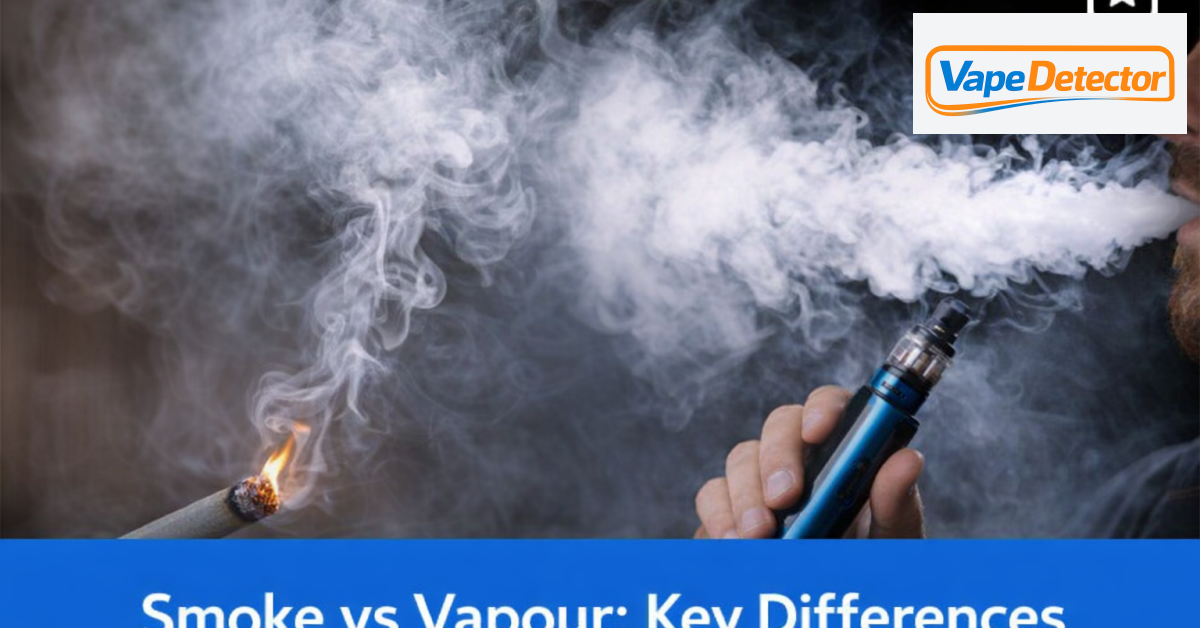
Smoke vs Vapour: Key Differences
Smoke and vapour look similar in the air, but they form in different ways and behave differently indoors. The distinction affects fire safety, indoor air quality, cleaning, and how detectors respond in homes and managed buildings.
Clear definitions also help with policy decisions in UK settings such as schools, workplaces, and short-term lets, where the wrong type of sensor or signage creates avoidable risk and confusion.
Definitions: Smoke And Vapour
Smoke and vapour refer to different airborne outputs. Smoke comes from combustion and includes solid particles and combustion gases. Vapour from e-cigarettes is more accurately described as an aerosol, made from tiny liquid droplets suspended in air, even when users call it “vapour”.
What Is Smoke?
Smoke is a mixture of gases and fine solid and liquid particles created when a material burns. Smoke forms when combustion is incomplete or when burning releases complex by-products rather than converting fuel fully into carbon dioxide and water.
Smoke from tobacco includes combustion products from the cigarette paper, additives, and the tobacco itself. Smoke from a fire depends on the burning materials, such as plastics, wood, or textiles, and the oxygen available.
What Is Vapour?
Vapour is a gas-phase form of a substance, such as water vapour in humid air. In everyday vaping language, “vapour” usually describes what an e-cigarette emits, but that output is primarily an aerosol.
E-cigarette aerosol forms when a liquid mixture heats and condenses into tiny droplets. The aerosol carries dissolved compounds from the liquid and trace compounds created by heating, depending on device settings and liquid composition.
Aerosol Vs Vapour: Common Terminology Differences
Aerosol is a suspension of fine solid particles or liquid droplets in air. E-cigarette output fits that definition because it contains droplets rather than only gas.
Vaping conversations often use “vapour” as a shorthand because the cloud disperses like steam. Technical and safety discussions often use “aerosol” to avoid confusion with water vapour and to reflect how sensors and ventilation systems respond.
How Smoke And Vapour Are Produced
The production method drives most of the differences in composition and detector response. Smoke forms through combustion, which breaks materials down and creates soot and combustion gases. E-cigarette aerosol forms through heating and evaporation of liquid ingredients, followed by condensation into droplets.
Understanding these mechanisms matters in UK buildings because standard smoke alarms are designed to detect combustion indicators, not vaping behaviour, even though some devices and conditions create overlap.
Combustion: How Smoke Forms
Combustion is a chemical reaction between a fuel and oxygen that releases heat and creates new compounds. In real-world burning, oxygen supply varies, so combustion often produces incomplete by-products such as soot and carbon monoxide.
Cigarette smoke forms because tobacco smoulders and burns at the tip. Fire smoke forms when building materials pyrolyse and burn, creating a changing mix of particles and gases as the fire develops.
Heating Without Combustion: How Vapour Forms
E-cigarettes heat an e-liquid using an electrical coil. The coil heats the liquid on a wick, and the heated components evaporate and then condense into droplets as the plume cools in the surrounding air.
Device power, coil temperature, airflow, and user puff style change the droplet size distribution and the amount of aerosol produced. Dry or overheated wicks increase thermal breakdown products compared with normal operation.
Temperature Ranges And What Changes In The Output
Combustion operates at high temperatures that break molecules apart and form soot, ash, and combustion gases. Heating without combustion operates at lower temperatures but still changes liquids when temperatures rise or when the coil runs hot.
Higher heating levels in vaping generally increase aerosol mass and may increase irritating by-products, particularly when liquid overheats. Higher combustion intensity generally increases smoke production and the speed at which smoke spreads and alarms activate.
What Smoke And Vapour Contain
Smoke and e-cigarette aerosol both contain airborne particles, but the particle type and accompanying gases differ. Smoke includes tar, soot, and combustion gases such as carbon monoxide. Vaping aerosol includes liquid droplets of carrier ingredients and dissolved compounds, plus smaller amounts of thermal degradation products.
These differences affect cleaning, odour persistence, exposure profiles, and how sensors interpret what is in the air.
Particulates, Tar, And Carbon Monoxide In Smoke
Cigarette smoke contains particulate matter and sticky residues commonly described as tar. Smoke particles include soot-like solids and condensed organic compounds that deposit readily on surfaces.
Carbon monoxide is a key combustion gas in smoke and a major safety concern because it displaces oxygen in the bloodstream. Fire smoke also carries a wide range of toxic gases depending on what burns, including irritant and corrosive compounds.
Aerosol Droplets And Carrier Liquids In Vapour
E-cigarette aerosol mainly consists of liquid droplets formed from heated carrier liquids. The most common carriers in e-liquids are propylene glycol and vegetable glycerine, often with flavourings and optional nicotine.
Droplet composition changes with device settings and liquid formulation. Some compounds remain in the gas phase as volatile organic compounds (VOCs), while many remain dissolved in droplets and deposit later as the aerosol settles or contacts surfaces.
Nicotine Delivery: How It Differs Between Products
Cigarettes deliver nicotine through smoke inhalation from burning tobacco. The delivery profile depends on cigarette design and smoking behaviour, and it includes combustion by-products alongside nicotine.
E-cigarettes deliver nicotine through aerosol droplets. Nicotine concentration, formulation (including nicotine salts versus freebase), device power, and puff topography all change the rate and amount of nicotine delivered. Nicotine delivery also varies widely across different e-cigarette products and user settings, which affects both user exposure and the strength of indoor plumes.
How Smoke And Vapour Behave Indoors
Indoor behaviour depends on particle size, humidity, ventilation, and how quickly particles deposit on surfaces. Smoke often produces a persistent odour and visible haze, and it leaves a sticky residue. Vaping aerosol often disperses faster but can still leave deposits and odour, especially in small, poorly ventilated spaces.
These behaviours matter for UK premises managers because complaints, cleaning costs, and detector activations often relate to where and how the plume travels.
Visibility, Smell, And Residue On Surfaces
Smoke tends to create a stronger lingering smell and more persistent staining because tar-like compounds adhere to paint, fabrics, and ventilation ducts. Yellowing and surface stickiness are common where smoking occurs indoors over time.
Vaping aerosol often produces a visible cloud that dissipates quickly in a well-ventilated room. Vaping deposits usually appear as a thin film on glass and other cool surfaces, and the smell often reflects the flavouring used, with persistence linked to ventilation and frequency of use.
Settling And Air Mixing In Typical Rooms
Room airflow mixes smoke and aerosol plumes, moving them away from the source and towards return vents, door gaps, and corridors. Warm plumes rise initially, then spread horizontally once they cool.
Smoke particles and gases often remain detectable longer because of their composition and the way they distribute through a building. Vaping aerosol droplets can evaporate, grow, or shrink depending on humidity, which changes how long they stay airborne and how they interact with sensors.
False Alarms: Why Some Sensors Trigger And Others Do Not
Optical smoke alarms respond to particles that scatter light. Dense vaping aerosol droplets can scatter light in a similar way to smoke, especially close to the device or in small rooms with poor ventilation, which increases nuisance alarms.
Heat alarms respond to rapid temperature rise rather than particles. Heat alarms generally ignore vaping aerosol because vaping does not create the heat signature of a fire. Multi-sensor fire alarms use combined inputs, so the trigger outcome depends on the device logic and alarm thresholds.
Health And Exposure Considerations
Combustion smoke and e-cigarette aerosol create different exposure profiles. Tobacco smoke includes carbon monoxide and many combustion by-products, while vaping aerosol includes carrier droplets and heating-related by-products that vary with device conditions.
Exposure discussions matter most in shared UK indoor environments, where building operators need to manage non-user exposure, odour complaints, and cleaning while also meeting fire safety obligations.
Secondhand Smoke Vs Secondhand Vapour: Key Distinctions
Secondhand smoke contains the same core combustion by-products as directly inhaled smoke, including fine particles and combustion gases. Secondhand smoke exposure in enclosed spaces accumulates quickly and often persists.
Secondhand e-cigarette aerosol contains exhaled droplets and gases from the device output. The composition and persistence depend heavily on ventilation, device type, and use intensity. The exposure profile differs from tobacco smoke because the aerosol does not include combustion products such as carbon monoxide in the same way, but it still introduces airborne chemicals and particulates into the room.
Thirdhand Residue: Smoke Versus Vapour Deposits
Thirdhand residue refers to contamination that remains on surfaces after airborne emissions settle. Tobacco smoke residue binds strongly to walls, ceilings, upholstery, and dust. Cleaning often needs degreasing agents and repeated repainting in heavily smoked-in rooms.
Vaping residue usually deposits as a lighter film, often on windows, mirrors, and electronics, and it can attract dust. The residue profile varies with carrier ratio and flavourings, and it tends to build up most where use is frequent and airflow is limited.
Ventilation And Filtration: What Changes The Most
Ventilation reduces indoor concentrations by replacing indoor air with outdoor air or by improving air movement to extraction points. Higher air change rates reduce both smoke and vaping aerosol concentrations faster.
Filtration performance depends on the filter type. Particulate filters address particles and droplets, while activated carbon targets some gases and odours. Smoke includes both fine particulates and problematic gases, so controlling smoke typically requires a broader approach than controlling short vaping events, even though both benefit from effective extraction.
Detection And Monitoring: Smoke Alarms Vs Vape Detectors
Smoke alarms and vape detectors use different sensing goals. Smoke alarms focus on early fire detection using combustion indicators. Vape detectors focus on identifying vaping-related aerosols or related gas signatures to support policy enforcement in places where vaping is prohibited.
Choosing the correct device affects safety compliance, nuisance alarms, and the reliability of incident reporting in UK buildings. For a clearer view of sensor inputs and alert logic, see what vape detectors detect in typical UK installations.
How Smoke Detectors Sense Combustion By-Products
Optical smoke detectors use a light source and sensor to detect scattered light from airborne particles. This approach works well for many smouldering fire scenarios and responds to visible smoke.
Ionisation smoke detectors use a small radioactive source to detect changes in ion flow when particles enter the sensing chamber. Ionisation alarms are less common in the UK consumer market than optical alarms, and building systems often use optical or multi-sensor devices.
How Vape Detectors Sense Aerosols And VOCs
Vape detectors use sensors designed to identify vaping events rather than fires. Many devices use particulate sensing, gas sensing for VOC changes, or a combination, then apply algorithms to reduce false positives.
Vape detectors often integrate with building management systems or alerting systems. Alert routing varies by installation and policy, such as sending an alert to facilities staff rather than sounding an evacuation alarm.
Sensitivity, Placement, And Typical Trigger Conditions
Sensor sensitivity determines whether a device responds to low-level background aerosols or only to concentrated plumes. Over-sensitive settings increase false alerts, while under-sensitive settings miss events in larger rooms or near extraction points.
Placement changes performance. Toilets, corridors outside toilets, and changing rooms present different airflow patterns and dilution rates. Trigger conditions often include proximity to the source, duration of use, ventilation rate, and whether the door remains closed during vaping.
Choosing The Right Sensor For The Environment
Sensor choice depends on the risk being managed. Fire risk calls for compliant fire detection and alarm devices. Policy enforcement for vaping calls for vape detection that does not compromise fire alarm integrity.
UK sites often need both, with clear separation between life-safety alarms and behavioural monitoring to avoid confusion and reduce nuisance activations.
Homes And Flats
Homes and flats typically rely on smoke alarms and heat alarms for fire detection. Optical smoke alarms suit many domestic areas, while heat alarms suit kitchens where cooking aerosols cause nuisance alarms.
Vape detection in domestic settings is uncommon and raises privacy concerns in shared households. Building owners and landlords usually focus on fire safety compliance and tenancy terms rather than dedicated vape monitoring.
Schools And Colleges
Schools and colleges often face repeated vaping incidents in toilets and stairwells. Vape detectors support staff response and safeguarding policies when installed with clear rules on alert handling and data retention.
Fire alarms in education settings need to reduce nuisance activations while maintaining rapid fire detection. Separating vape detection alerts from fire alarm sounders prevents confusion during genuine evacuations.
Workplaces, Toilets, And Public Buildings
Workplaces and public buildings often place vape detectors in toilets, entrances, and areas with frequent complaints. Airflow in toilets and plant-driven extraction affects detection thresholds and placement height.
Facilities teams often use vape detector alerts to target cleaning, maintenance, and compliance activity. Fire detection remains a separate life-safety system with dedicated maintenance and testing schedules.
Hospitality Venues And Short-Term Lets
Hospitality venues manage a mix of smoking rules, customer behaviour, and rapid room turnaround. Vapour deposits and odours affect cleaning time and guest complaints, especially in en-suite bathrooms with limited extraction.
Short-term lets face similar issues, with the added challenge of limited on-site staff response. Sensor choices often prioritise clear incident evidence and straightforward maintenance without increasing fire alarm false alarms.
Compliance And Policy Considerations In The UK
UK compliance involves more than detector selection. Fire safety duties, building policies, and privacy requirements shape what monitoring is appropriate and how alerts are handled.
Clear documentation and consistent enforcement reduce disputes and improve safety outcomes, especially in shared or managed buildings.
Fire Safety Responsibilities And Alarm Selection
Fire safety responsibilities depend on the type of premises and the responsible person under relevant UK fire safety frameworks. Fire detection and alarm systems need appropriate design, installation, commissioning, and maintenance for the building’s risk profile.
Alarm selection focuses on early detection, reliability, and avoiding nuisance alarms that lead to alarm fatigue. Any additional sensors installed for vaping policy enforcement need to avoid interfering with fire alarm coverage or evacuation signals.
Vape Policies, Signage, And Enforcement Basics
Vape policies define where vaping is prohibited and what responses apply when a rule is broken. Signage works best when it states the restriction plainly and matches staff procedures.
Enforcement depends on consistent handling, accurate records, and proportionate responses. Vape detector alerts are more useful when the policy defines who receives the alert, how quickly staff respond, and what evidence is retained.
Privacy And Monitoring: What To Check Before Installing Sensors
Privacy checks focus on whether a device records audio, captures images, or logs identifiable information. Many vape detectors do not use cameras, but alert logs still count as monitored data if they link to individuals through time and location.
Governance checks include data retention periods, access controls, and clear communication to occupants. Procurement checks focus on what data leaves the building, whether cloud services process it, and what contractual terms apply.
FAQs
Is Vapour The Same As Smoke?
Vapour is not the same as smoke. Smoke comes from combustion and contains combustion particles and gases. E-cigarette output is mainly an aerosol of liquid droplets formed by heating e-liquid.
Does Vaping Set Off Smoke Alarms?
Vaping sets off some smoke alarms, especially optical alarms near the source or in small rooms with weak ventilation. Dense aerosol droplets scatter light in a similar way to smoke particles. Heat alarms generally do not respond to vaping because vaping does not create a rapid temperature rise.
Do Vape Detectors Detect Cigarette Smoke?
Some vape detectors respond to cigarette smoke, depending on the sensor types and configuration. Cigarette smoke contains particulates and VOCs, so overlap exists. A vape detector does not replace a smoke alarm for fire safety.
Does Vapour Leave A Smell Or Stain Walls?
Vaping often leaves a smell related to flavourings, and the smell persistence depends on ventilation and frequency of use. Vaping residue generally forms a light film rather than the heavy staining associated with tobacco smoke, but build-up occurs over time in enclosed rooms.
Is Passive Exposure The Same For Smoke And Vapour?
Passive exposure is not the same. Secondhand smoke includes combustion gases such as carbon monoxide and a different mix of toxic by-products. Secondhand e-cigarette aerosol contains droplets and gases that vary with device settings and liquids, and the exposure profile differs from smoke even though it still affects indoor air.
Conclusion
Smoke and vapour differ primarily because combustion creates smoke, while heated e-liquid creates an aerosol that users often call vapour. The production method drives differences in composition, indoor behaviour, residue, and detector response.
Fire safety detection focuses on combustion indicators, while vape detection focuses on aerosol or VOC signatures for policy monitoring. Matching the sensor type to the environment supports safety compliance, reduces nuisance alarms, and improves incident handling in UK settings.