
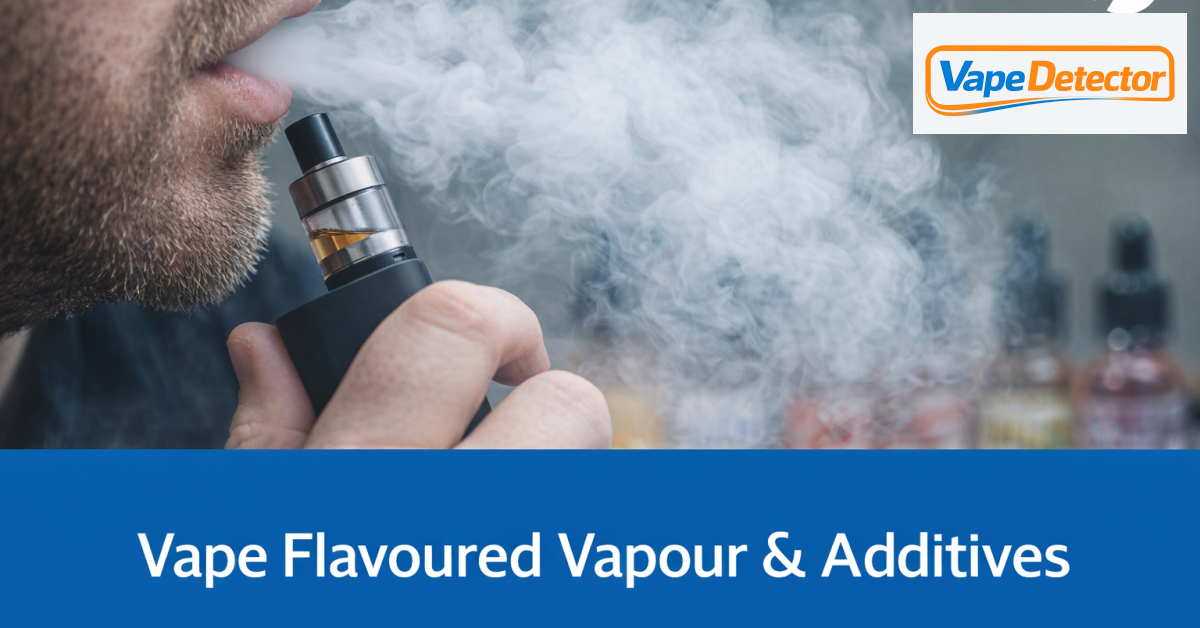
Flavoured Vapour & Additives
Flavoured vapour describes the aerosol produced when an e-liquid is heated and inhaled, with added flavour compounds that change smell, taste, and sometimes the feel of the inhale. Additives are extra ingredients used to alter sweetness, cooling sensation, thickness, stability, or appearance. Both affect how vapour behaves in air and how easily it is detected indoors.
Vape detectors and air quality sensors respond to particles, gases, or a combination of both. Flavours and additives change particle formation, chemical composition, and residue. Those changes influence detection reliability, nuisance alerts, and maintenance needs in places such as toilets, stairwells, schools, and workplaces.
What Flavoured Vapour Means In Practice
Flavoured vapour results from heating a mixture of carrier liquids, nicotine (or none), and flavour compounds. The output is an aerosol made of tiny droplets and gases, not “steam”. The practical impact is strongest indoors, where airflow is limited and odours and residues accumulate.
Flavour type, e-liquid base, and user behaviour combine to set plume density and persistence. Those factors affect both how noticeable vapour is to people and how it registers on detection systems.
Flavour Compounds And Carrier Liquids
Flavour compounds are chemicals added at low concentrations to create specific taste and aroma profiles. Many flavours use food-grade ingredients, but inhalation exposure differs from ingestion, and ingredient behaviour changes when heated.
Carrier liquids form the bulk of e-liquid:
- Propylene glycol (PG) carries flavour well and often produces a sharper throat sensation.
- Vegetable glycerine (VG) produces thicker, more visible aerosol and a smoother inhale.
Flavour compounds dissolve in the PG/VG base. The mixture then aerosolises when heated, forming droplets that carry flavour molecules and other volatile components into the air.
Flavoured Vapour Vs Aerosol And Smoke
Flavoured vapour is more accurately described as aerosol. Aerosol contains suspended liquid droplets and gases created by heating e-liquid. Smoke is the product of combustion and includes soot and a different mix of combustion by-products.
Aerosol and smoke behave differently:
- Aerosol droplets can evaporate, change size, and settle as residue.
- Smoke particles often persist longer and include solid particulates that behave differently in sensors.
Vape detectors typically target aerosol-related particle signatures, gaseous compounds, or both, rather than combustion smoke alone.
Common Flavour Profiles And Where They Appear
Common flavour profiles include fruit, menthol or “ice”, desserts, sweets, drinks, and tobacco-style blends. Some profiles appear more often in specific settings because of user preference and concealment attempts.
Fruit and sweet flavours often appear in shared indoor spaces because the odour is familiar and sometimes perceived as less suspicious. Menthol and coolant-heavy flavours often appear where users aim to reduce lingering smell, even though cooling agents can still produce a distinctive scent.
What Additives Are And Why They Are Used
Additives are ingredients beyond the core carrier liquids, nicotine (optional), and standard flavour compounds. Additives change sensory experience, vapour characteristics, shelf stability, and appearance. Additives also affect how aerosol behaves in air and how much residue forms on surfaces and sensors.
Additive use matters for detection because it changes droplet formation, evaporation rate, and volatile emissions. It also affects how quickly deposits build up in confined areas.
Sweeteners, Coolants, And Acidity Regulators
Sweeteners intensify perceived sweetness and smooth harshness. Some sweeteners contribute to coil deposits and can increase the amount of residue released into the air as fine droplets and condensed material.
Coolants create a cooling sensation without a strong mint taste. Coolant-heavy liquids often produce a recognisable “cold” odour profile and can change the irritant feel of the aerosol, affecting how users exhale and how long they hold vapour.
Acidity regulators adjust pH and can influence nicotine harshness and stability. Changes in pH can alter the sensory profile and may change the mix of volatile compounds emitted during use.
Thickening Agents And Viscosity Modifiers
VG itself acts as a thick component in many liquids, but other ingredients may modify viscosity to change wicking behaviour, mouthfeel, or plume density. Higher viscosity often links with denser visible output, especially at higher power.
Viscosity changes also influence droplet size distribution after aerosolisation. That matters for particle-based detection, because sensors respond differently to different particle sizes and concentrations.
Preservatives, Colourants, And Other Less Common Additives
Preservatives aim to slow degradation of ingredients and extend shelf life. Some liquids include colourants for appearance, although colour does not directly predict aerosol behaviour.
Less common additives include compounds used to adjust aroma persistence or mouthfeel. These ingredients can increase the likelihood of lingering odour in poorly ventilated spaces and contribute to surface film build-up over time.
How Flavours And Additives Affect Vapour Detection
Vape detection relies on recognising changes in indoor air consistent with vaping. Flavours and additives change both the particle component (droplets) and the gas component (volatile chemicals). The same user behaviour can produce different sensor readings depending on liquid composition.
Reliable detection depends on matching sensor type to the expected emissions and the environment. Flavour-heavy use in confined areas tends to amplify both odour persistence and residue formation.
Particle Size And Sensor Response
Aerosol particle size varies with device power, coil temperature, airflow, and liquid composition. Particle sensors respond to particle concentration and size ranges, so the same vaping event can look different across liquids.
Higher VG mixes often produce larger and denser plumes, which increases particle load in the air for a short period. Sweeteners and heavier flavouring can increase condensable material, which supports droplet formation and persistence in still air.
Volatile Organic Compounds (VOCs) And Gas Sensors
Flavour compounds and additives release VOCs that contribute to smell and gas-phase signatures. Gas sensors respond to certain VOC patterns, but sensor specificity varies by technology.
Some environments include background VOC sources such as cleaning products, air fresheners, perfumes, and cooking fumes. Flavour-heavy vaping adds another VOC source, so detection logic needs context to separate likely vaping events from routine background changes.
Residue, Build-Up, And Long-Term Sensor Drift
Aerosol droplets deposit on surfaces, forming a film that traps odours and attracts dust. Sweeteners and high-VG liquids often correlate with more visible residue on nearby surfaces, though ventilation and cleaning frequency strongly influence outcomes.
Residue affects detectors in two ways:
- Optical and air-path contamination reduces sensitivity and increases noise in particle readings.
- Surface build-up changes airflow and sensor exposure, contributing to long-term drift.
Maintenance schedules need to reflect both vaping frequency and the types of liquids commonly used in the area.
Device Settings That Change Flavoured Vapour Output
Device settings influence aerosol volume, droplet size, temperature-driven chemistry, and plume visibility. Two users with the same liquid can produce very different outputs indoors based on power and airflow choices.
Settings matter for detection because detectors respond to concentration spikes and persistence. Higher output and slower dispersal increase the chance of an alert in confined spaces.
Power, Coil Temperature, And Aerosol Production
Higher power increases coil temperature and typically increases aerosol production per puff. Higher temperature also changes how flavours volatilise and how quickly carrier liquids aerosolise.
Very high temperatures increase the risk of harsh by-products and “burnt” odour signals. Lower-power devices often produce smaller plumes but can still generate detectable VOC changes in small rooms.
Airflow, Inhalation Style, And Exhaled Plume Density
Airflow settings affect dilution inside the device and the density of the exhaled plume. Tighter airflow tends to produce a warmer, more concentrated draw, while open airflow often produces a larger volume of aerosol.
Inhalation style changes indoor concentration:
- Mouth-to-lung use often creates smaller exhaled clouds but repeated puffs in the same space.
- Direct-to-lung use often creates larger single exhalations and more rapid room loading.
Holding vapour before exhale reduces visible plume but does not remove VOC emissions. It also shifts deposition patterns because more aerosol condenses in the airways and the remaining exhale composition changes.
PG/VG Ratio And Visible Vapour
PG/VG ratio strongly influences visibility and dispersal. Higher VG usually increases visible vapour density and creates a thicker plume that lingers in still air.
Higher PG often reduces visible density but increases perceived throat hit and can carry aroma efficiently. Reduced visibility does not guarantee reduced detectability, because VOC signals and fine droplets still affect sensors in enclosed spaces.
Common Environments Where Flavoured Vapour Causes Issues
Flavoured vapour causes the most operational issues in enclosed, high-turnover areas with limited ventilation. Odours travel through corridors and vents, and residue accumulates in corners, around extraction points, and on fixtures.
Site managers typically focus on spaces where privacy, low supervision, and short dwell times combine. Those conditions increase frequency of vaping events and reduce the chance of immediate intervention.
Toilets, Changing Rooms, And Stairwells
Toilets and changing rooms provide privacy and often have intermittent ventilation. Air fresheners and cleaning chemicals also raise background VOC levels, which complicates interpretation if detection relies on gas sensing alone.
Stairwells act as vertical air channels. Vapour rises and spreads across floors, creating complaints away from the point of use and increasing the value of placement that accounts for airflow paths.
Schools, Colleges, And Student Accommodation
Schools and colleges often see vaping in toilets, corridors near exits, and secluded stairwells. Student accommodation adds bedrooms and shared kitchens, where cooking and sprays create complex background conditions.
Policy enforcement often depends on timely alerts and reliable evidence of repeated patterns. Detector configuration and logging practices matter because false alarms reduce trust and response speed.
Workplaces, Hospitality, And Transport Hubs
Workplaces face vaping in toilets, loading bays, and break areas, especially where smoking areas are inconvenient. Hospitality venues add kitchen aerosols, cleaning chemicals, and fragrance use, which raise the baseline for both particle and VOC readings.
Transport hubs introduce high footfall and door openings that change airflow rapidly. Detector placement needs to account for drafts, extraction fans, and changing occupancy.
Risk, Safety, And Compliance Considerations
Flavoured vapour introduces health, comfort, and compliance concerns indoors. Policies often focus on protecting shared air quality, reducing complaints, and maintaining safe conditions around alarms and ventilation systems.
UK compliance requirements depend on setting, internal policy, and relevant health and safety duties. Clear, consistent rules reduce disputes and simplify enforcement.
Allergy And Sensitivity Considerations
Fragrances and flavour compounds trigger symptoms for some people, including headaches, nausea, and irritation. Sensitivity risk rises in small rooms and in environments where exposure is repeated.
Workplaces and education settings often manage sensitivities through designated vaping areas and enforced no-vaping zones. Incident reports that note symptom complaints help target problem locations and times.
Passive Exposure And Indoor Air Quality
Passive exposure depends on room volume, ventilation rate, frequency of vaping, and the type of device and liquid. Even when visible vapour dissipates quickly, odour and VOCs can persist, especially in soft furnishings and porous surfaces.
Indoor air quality management relies on controlling sources and improving ventilation rather than masking smells. Air fresheners reduce perceived odour for some people but add VOCs that complicate detection and may worsen symptoms for others.
Policies On Vaping And “No Vaping” Areas
No-vaping policies set expectations for occupants and simplify enforcement. Clear signage, consistent consequences, and staff procedures reduce repeat incidents.
Policy wording benefits from precision. Terms such as “vaping devices”, “e-cigarettes”, and “heated aerosol products” reduce loopholes. Policy documents often specify locations, exemptions (if any), and how incidents are recorded and escalated.
Choosing Vape Detectors For Flavoured Vapour Scenarios
Detector selection depends on what needs detecting and how the environment behaves. Flavoured vapour scenarios often require balancing sensitivity with resilience against background VOCs and routine aerosols from cleaning products.
Procurement decisions also depend on integration needs, response workflows, and ongoing maintenance capacity. A detector that alerts reliably but requires frequent servicing may not suit high-use toilets without a realistic maintenance plan.
Sensor Types And What Each Detects
Particle sensors detect changes in aerosol concentration and particle size distribution. Gas sensors detect changes linked to VOCs and other gases associated with vaping and indoor activities.
Multi-sensor devices combine signals to improve decision-making. Combined sensing supports better discrimination between vaping, deodorant spray, steam, and cleaning activities, but performance still depends on calibration and configuration for the site.
Placement And Coverage For High-Use Areas
Placement determines whether a detector sees the plume before it disperses. Toilets often need coverage that accounts for cubicles, extraction points, and common concealment spots.
Placement decisions also consider tamper risk and cleaning exposure. Mounting height, airflow direction, and distance from vents and doors affect reliability. Coverage planning works best when matched to typical movement patterns and ventilation behaviour.
Alert Thresholds And Reducing Nuisance Alarms
Alert thresholds set the point at which an event triggers notification. Thresholds that are too low increase nuisance alarms from sprays and cleaning. Thresholds that are too high miss short, low-output vaping.
Configuration benefits from a controlled tuning period that compares alerts to on-site observations and incident logs. A stable approach uses consistent thresholds across similar rooms, then adjusts only when evidence shows a persistent mismatch.
Maintenance And Operational Checks For Flavoured Vapour
Maintenance keeps sensors accurate in environments with frequent aerosol and VOC exposure. Flavoured vapour increases the risk of residue build-up, especially where ventilation is weak and cleaning products add additional airborne compounds.
Operational checks reduce downtime and prevent gradual performance loss. A documented process supports accountability and helps separate genuine performance issues from environmental changes.
Cleaning And Filter Replacement
Cleaning removes deposits that obstruct airflow and contaminate sensor surfaces. Filter replacement maintains consistent air intake and reduces dust and residue reaching internal components.
Maintenance frequency depends on usage patterns and the environment. Toilets with high vaping frequency and regular air freshener use often require more frequent checks than corridors with strong ventilation.
Calibration And Performance Verification
Calibration aligns sensor readings with expected baselines and response behaviour. Performance verification confirms that alerts trigger under realistic conditions and that the device responds consistently over time.
Verification routines also check for environmental changes, such as new cleaning regimes, altered ventilation schedules, or building works that increase dust. Those changes shift baselines and affect detection reliability.
Incident Logs And Pattern Recognition
Incident logs record time, location, alert type, and outcome. Consistent logging helps identify repeat hotspots, peak times, and correlations with events such as breaks, lessons ending, or shift changes.
Pattern recognition supports targeted responses, such as adjusting patrol timing, improving ventilation in a specific toilet block, or refining detector thresholds where nuisance alarms cluster. Record quality determines how useful the trend analysis becomes.
FAQs
What Is Flavoured Vapour?
Flavoured vapour is a vape aerosol that includes flavour compounds designed to change taste and smell. Flavoured vapour includes airborne droplets and gases produced when an e-liquid is heated.
What Counts As An Additive In E-Liquid?
An additive in e-liquid is an ingredient added to modify sweetness, cooling sensation, acidity, viscosity, stability, or appearance. Sweeteners, coolants, and viscosity modifiers are common examples.
Do Sweeteners And Coolants Make Vapour More Detectable?
Sweeteners and coolants change vapour composition and odour profile, which can increase detectability in some environments. Detection depends on sensor type, room ventilation, and how concentrated the exhaled plume is.
Does High-VG Liquid Increase Visible Vapour And Detection Risk?
High-VG liquid often increases visible vapour and plume density. Higher visibility often correlates with higher particle concentration, which increases the chance of detection by particle-focused sensors in enclosed spaces.
Can Flavoured Vapour Trigger False Alarms In Vape Detectors?
Flavoured vapour triggers alerts as intended when a detector targets vaping signatures. Nuisance alarms more often come from non-vape aerosols or VOC sources such as deodorant sprays, cleaning products, and steam, depending on the sensor configuration.
How Often Do Vape Detectors Need Cleaning In High-Vaping Areas?
Cleaning frequency depends on vaping frequency, ventilation, and the presence of sprays and dust. High-use toilets and changing rooms often need more frequent checks than low-use corridors because residue builds up faster.
Conclusion
Flavoured vapour combines aerosol droplets and volatile compounds from carrier liquids, flavourings, and additives. Those ingredients influence plume density, odour persistence, and residue, which directly affects how vape detectors perform in enclosed indoor spaces. Effective detection in flavour-heavy environments depends on selecting suitable sensor types, placing devices where plumes travel, setting thresholds that match the local background conditions, and maintaining sensors to prevent drift and nuisance alerts.