
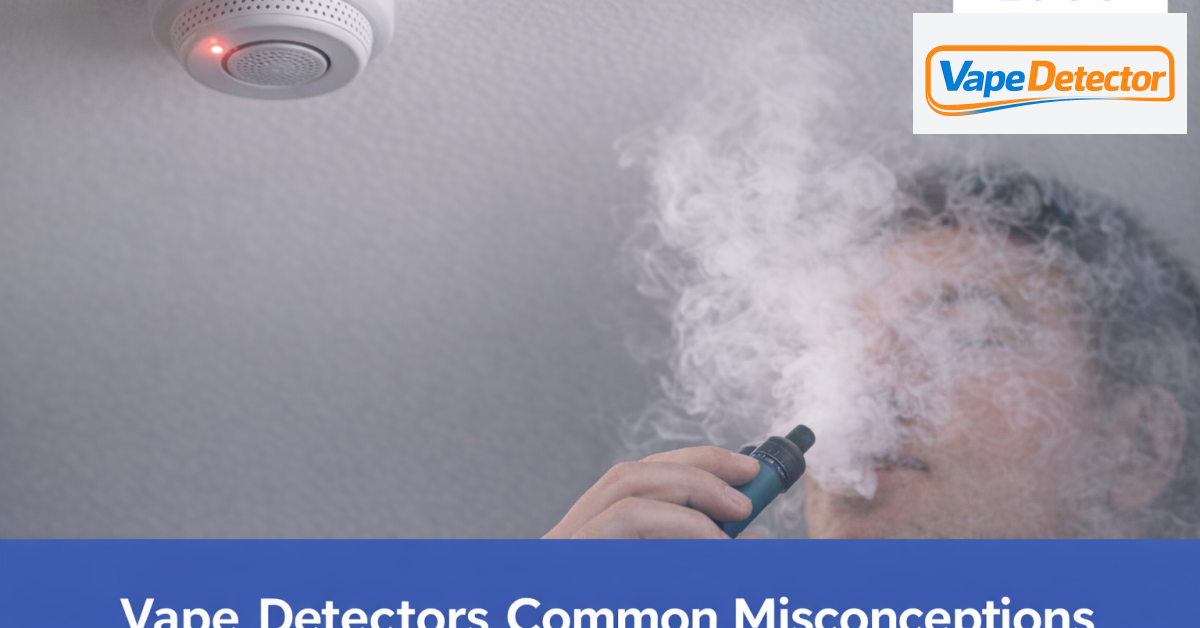
Common Misconceptions
Vape detectors and sensors support safeguarding and site management by alerting staff to airborne changes linked to vaping. Clear expectations matter because sensor alerts often feed into behaviour policies, incident logs, and staff response decisions.
Misconceptions usually fall into three areas: what sensors measure, how reliable detection is in real buildings, and what responsibilities remain around privacy, procedures, and compliance. The explanations below separate marketing claims from practical performance factors.
What Vape Detectors And Sensors Do And Do Not Do
Vape detectors and sensors monitor air quality indicators associated with vaping aerosols. Most devices infer vaping from patterns in particulates and volatile organic compounds rather than identifying a specific substance. Understanding limits reduces avoidable escalations and improves outcomes in schools, workplaces, and public venues.
Operational success depends on realistic use cases. Vape detectors support staff action and policy enforcement, but they do not replace supervision, training, or a consistent response process.
For a clearer overview of realistic expectations, see the benefits and limitations of vape detectors in typical safeguarding and site-management use cases.
Misconception: A Vape Detector Identifies Nicotine Or THC
Vape detectors do not directly identify nicotine, THC, or named drugs in the air. Vape detectors measure physical or chemical indicators such as particulate concentration and VOC changes, then apply algorithms to classify a likely vaping event.
Nicotine-free vapes and flavoured aerosols often produce similar sensor signatures to nicotine-containing products. A sensor alert therefore indicates a probable aerosol event, not the content of the aerosol.
Misconception: Vape Detectors Replace Staff Supervision
Vape detectors provide alerts, not enforcement. Staff presence, supervision patterns, and safeguarding routines remain necessary because sensor coverage never equals constant oversight across all behaviours and locations.
A strong operational model links alerts to proportionate actions, documentation, and follow-up. A weak operational model treats an alert as a complete investigation, which increases conflict risk and reduces trust.
Misconception: Vape Detectors Work Reliably In Every Space
Building layout and airflow strongly affect detection performance. Small enclosed rooms often produce clearer detection signals than large open areas with high air exchange.
Some locations create persistent sensor noise. Workshops, kitchens, changing rooms, and spaces with frequent aerosols need additional tuning, alternative placement, or a different approach to alert thresholds.
Vape detectors work best when the environment and expectations match the device’s sensing method.
How Vape Detection Works In Practice
Vape detection works by measuring changes in air composition and comparing them to known patterns for vaping aerosols. Real-world performance depends on where the sensor samples air, how air moves through the room, and how quickly signals dissipate.
Effective deployments treat coverage as a site design task rather than a single-device purchase. Sensor count, placement, and response time requirements determine whether alerts arrive early enough to be useful.
Misconception: Sensors Detect “Vape Smoke” Like A Smoke Alarm
Vape aerosols behave differently from smoke from combustion. Vape aerosols often disperse quickly and can be influenced heavily by ventilation, door opening, and extractor fans.
Many vape detectors use multiple sensing inputs to recognise aerosol patterns. Smoke alarms focus on fire safety and often use different detection principles and alarm thresholds.
Misconception: One Sensor Covers An Entire Building
A single sensor covers a limited volume of air, and that coverage changes with airflow and barriers. Walls, doors, ceiling height, and ventilation routes reduce effective detection range.
Multi-storey buildings and long corridors usually need several sensors for meaningful coverage. Coverage planning focuses on higher-risk areas and the paths people use, not just square metres.
Misconception: Ventilation And Airflow Do Not Affect Detection
Ventilation alters both dilution and transport of aerosols. High extraction can remove aerosol before the sensor samples it, and supply vents can push aerosols away from the sensor.
Airflow also creates uneven mixing. A sensor in a stagnant corner may see a strong event, while a sensor near a supply vent may see a weak or delayed signal from the same behaviour.
Vape detection works best when airflow patterns are understood and placement matches those patterns.
Accuracy, Sensitivity, And False Alerts
Accuracy describes how often alerts align with real vaping events in the specific environment. Sensitivity controls how readily a device triggers when airborne changes occur. Both interact with false positives and false negatives.
A practical aim is usable alerts that arrive quickly enough for staff to respond, without creating constant nuisance alerts. Tuning and validation on-site often matter more than headline specifications.
Misconception: No False Positives Or False Negatives Occur
False positives occur when non-vaping aerosols resemble vaping patterns. False negatives occur when a vaping event is too small, too brief, too well ventilated, or too far from the sensor to trigger.
Common non-vaping triggers include:
- Deodorant, body spray, hair spray, and aerosol cleaners
- Steam bursts from showers or hot taps
- Dust disturbance from cleaning
- Some strong fragrances or solvent-based products
False alerts do not mean a system fails. False alerts mean the environment and thresholds need calibration, and staff need a proportionate response process.
Misconception: Higher Sensitivity Always Improves Results
Higher sensitivity increases detection of small events, but it often increases nuisance alerts. Higher sensitivity also increases alert fatigue, which reduces response consistency and undermines safeguarding.
Lower sensitivity reduces nuisance alerts but risks missing brief events. Balanced settings reflect site priorities, typical room use, and the acceptable trade-off between missed detections and nuisance alarms.
Misconception: All Detectors Perform The Same In Real Conditions
Sensor hardware, algorithm design, and filtering differ across manufacturers and models. Devices also differ in how they handle humidity, airflow, and cross-sensitivity from sprays.
Real-world performance depends on configuration options, data handling, and integration with existing systems. Two devices with similar marketing descriptions can behave differently in the same corridor or toilet block.
Accuracy needs validation in the actual rooms where incidents occur.
Placement And Environment Factors
Placement determines what air the sensor samples and how quickly a signal reaches it. Environmental factors determine whether the sensor sees vaping patterns clearly or sees competing aerosols.
Good placement reduces both missed detections and nuisance alerts. Poor placement often creates “unreliable” behaviour that is actually predictable once airflow and room use are mapped.
Misconception: Any Location On A Ceiling Works
Ceiling placement alone does not guarantee good sampling. A sensor near an extractor may see rapid dilution, while a sensor near a supply vent may see disturbed air that masks patterns.
Obstructions also matter. Beams, bulkheads, and high-level cupboards can create dead zones. Door position and typical occupancy locations affect where aerosol travels.
Misconception: Bathrooms Are The Only Areas That Need Coverage
Toilets are common vaping locations, but risk often spreads to corridors, stairwells, changing rooms, and secluded communal areas. A coverage plan that focuses only on toilets often misses displacement, where behaviour moves to less monitored spaces.
Risk-based coverage uses incident history, supervision gaps, and building layout. The aim is deterrence and timely alerts where staff can act safely and proportionately.
Misconception: Humidity, Aerosols, And Sprays Do Not Matter
Humidity changes and frequent aerosols introduce noise into sensor readings. Steam and aerosolised products can resemble vaping, especially in small rooms.
Cleaning routines also matter. Intensive spray cleaning shortly before peak times can increase nuisance alerts. Sites often reduce false alerts by adjusting cleaning products, changing cleaning schedules, or tuning alert thresholds.
Placement and environmental controls work together to reduce avoidable alerts.
Connectivity, Alerts, And Response Workflows
Vape detectors rely on connectivity to deliver alerts and log events. Alert handling determines whether information reaches the right person quickly and whether the response remains consistent.
A response workflow defines who receives alerts, how staff verify conditions, and how incidents are recorded. Without a workflow, even accurate alerts produce inconsistent outcomes.
Misconception: Wi‑Fi Always Provides Reliable Alerts
Wi‑Fi reliability depends on signal strength, congestion, roaming behaviour, and power availability. Toilets and plant rooms often have weaker coverage due to building materials and distance from access points.
Hardwired connections, dedicated networks, or supervised cellular connections sometimes provide more consistent delivery. Connectivity planning matters as much as sensor placement because delayed alerts reduce practical usefulness.
Misconception: Alerts Always Provide Proof Of Vaping
An alert indicates a sensor classification, not definitive proof. Sensors detect environmental patterns, not the identity of a person or the content of the aerosol.
Staff actions therefore need to remain proportionate. An alert supports a check, supervision adjustment, or safeguarding conversation. An alert alone rarely supports a conclusive finding without corroboration.
Misconception: Real-Time Alerts Remove The Need For Clear Procedures
Real-time alerts still require clear procedures for escalation, safeguarding, and record keeping. Staff need guidance on what to do when an alert occurs during a lesson, during a busy shift, or when lone working applies.
Procedures also reduce inconsistent enforcement. Consistency protects staff and users by reducing subjective decisions and helping sites apply policies fairly.
Connectivity and workflow design determine whether alerts improve safety or create noise.
Privacy, Data Protection, And Safeguarding
Privacy expectations influence acceptance and compliance. Data protection obligations apply when devices process data that relates to identifiable individuals, directly or indirectly, through logs and incident handling.
Safeguarding benefits increase when sites communicate clearly about sensor purpose, what data is collected, and how it is used. Transparency reduces complaints and reduces misunderstanding among users and staff.
Misconception: Vape Detectors Record Audio Or Video By Default
Many vape detectors do not record audio or video, but some models include optional features such as sound level monitoring or integrations with other systems. A specification check is necessary before purchase and before deployment.
A privacy assessment needs to match the actual configuration. A device that supports audio does not automatically record it, but a device that is configured to record requires clear controls and a lawful basis.
Misconception: Using Sensors Removes GDPR Responsibilities
Sensor deployment does not remove GDPR responsibilities. Data handling still includes access control, retention periods, incident logs, and management of subject rights where personal data exists.
A school or organisation remains responsible for governance decisions even when a supplier provides the hardware or dashboard. Supplier contracts and data processing terms affect accountability and security controls.
Misconception: Signage And Transparency Are Optional
Signage supports fairness and reduces conflict. Clear notices explain monitoring presence and purpose, and they help set behavioural expectations.
Transparency also supports safeguarding. When users understand that sensors detect air quality changes rather than filming people, concerns often reduce and staff conversations become simpler.
Privacy and safeguarding outcomes improve when governance and communication are designed in from the start.
Installation, Maintenance, And Ongoing Costs
Installation quality affects long-term reliability. Ongoing costs include network support, periodic checks, cleaning, and configuration management. Ignoring maintenance often increases nuisance alerts and missed detections over time.
A realistic cost view includes staff time for response and incident handling. A device that generates frequent false alerts creates operational cost even if the hardware cost is low.
Misconception: Installation Is Always “Fit And Forget”
Installation requires validation in the real environment. Validation includes checking alert delivery, confirming coverage, and confirming that typical non-vaping aerosols do not trigger frequent alerts.
Physical installation also needs safe cable routes, secure mounting, and access for servicing. A poor installation increases tampering risk and increases downtime.
Misconception: Calibration And Firmware Updates Are Not Needed
Some devices require periodic calibration checks, and many devices use firmware updates to improve detection performance and security. Update management matters for sites that rely on consistent behaviour over months and years.
Firmware updates also interact with policy and training. A threshold change or alert-type change affects how staff interpret events, so change control matters.
Misconception: Battery-Powered Units Require No Upkeep
Battery-powered units reduce cabling needs, but batteries require replacement or recharging on a schedule. Battery health affects sensor uptime and alert delivery.
A maintenance plan needs asset tracking, battery schedules, and checks for connectivity. A device that loses power in a high-risk area produces a false sense of coverage.
Installation and maintenance define the real cost and reliability of vape detection.
UK Compliance And Policy Alignment
UK sites often deploy vape detectors in schools, local authority settings, workplaces, and hospitality venues. Compliance requires alignment with site policies, employment rules where relevant, and data protection duties.
Policy alignment reduces disputes by defining expected behaviour, investigative steps, and escalation limits. A clear policy also supports staff confidence when responding to alerts.
Misconception: Any Device Marketed As A Vape Detector Meets UK Requirements
Marketing labels do not confirm suitability for a specific site. Suitability depends on safety standards, data handling, installation constraints, and whether the device’s operation matches the site’s risk and privacy expectations.
Procurement checks normally cover supplier support, warranty terms, update policies, and documentation for governance. A device that lacks clear documentation increases operational risk.
Misconception: A Vape Detector Policy Is The Same As A Smoking Policy
Smoking policies often focus on designated smoking areas and fire risk. Vape detector policies focus on indoor vaping, safeguarding, and response to alerts.
A vape detector policy often covers alert handling, record keeping, staff roles, and how the site avoids unfair assumptions. A smoking policy rarely covers sensor alerts, thresholds, or incident workflow detail.
Misconception: Enforcement Outcomes Are The Same In Every Setting
Schools, workplaces, and public venues apply different rules and processes. Age, safeguarding duties, employment law considerations, and visitor management change what a proportionate response looks like.
A consistent principle still applies: an alert triggers a check and a managed response, not an automatic conclusion. Policy alignment sets boundaries that staff follow in each setting.
UK compliance improves when device capability, privacy governance, and site procedures match the real operational environment.
FAQs
Do Vape Detectors Detect Nicotine, THC, Or Specific Drugs?
Vape detectors do not directly detect nicotine, THC, or named drugs. Vape detectors detect airborne patterns linked to aerosols, then classify an event as likely vaping based on sensor inputs and algorithms.
Are Vape Detectors The Same As Smoke Alarms?
Vape detectors are not the same as smoke alarms. Smoke alarms focus on fire detection and use alarm thresholds designed for combustion smoke. Vape detectors focus on aerosol patterns associated with vaping and often use different sensing and filtering methods.
What Causes False Alerts On Vape Detectors?
False alerts happen when non-vaping aerosols resemble vaping. Common causes include deodorant sprays, cleaning aerosols, steam, dust from cleaning, and some strong fragrances. Poor placement near vents and extractors also increases nuisance alerts.
Where Should A Vape Detector Be Installed For Best Results?
Best placement depends on room size, airflow, and typical behaviour locations. Toilets often need careful placement away from direct extraction paths. Corridors and other secluded areas sometimes need coverage if incidents move away from monitored toilets.
Do Vape Detectors Record Audio Or Video?
Many vape detectors do not record audio or video, but some models include optional features or integrations that involve sound or other data. Specification checks and configuration controls determine what data is processed on-site.
Do Vape Detectors Work In Toilets With Extractor Fans?
Vape detectors work in toilets with extractor fans, but extractor strength and airflow direction affect reliability and response time. Placement and threshold tuning matter more in highly ventilated toilets because aerosols disperse quickly.
Conclusion
Vape detector misconceptions usually come from treating sensors as proof, assuming one device solves every space, or overlooking the effect of airflow and aerosols. Reliable outcomes depend on matching the device to the environment, installing and tuning it correctly, and using clear response procedures.
A practical approach combines realistic expectations, privacy governance, and routine maintenance. That combination keeps alerts useful for safeguarding and site management rather than creating noise and disputes.