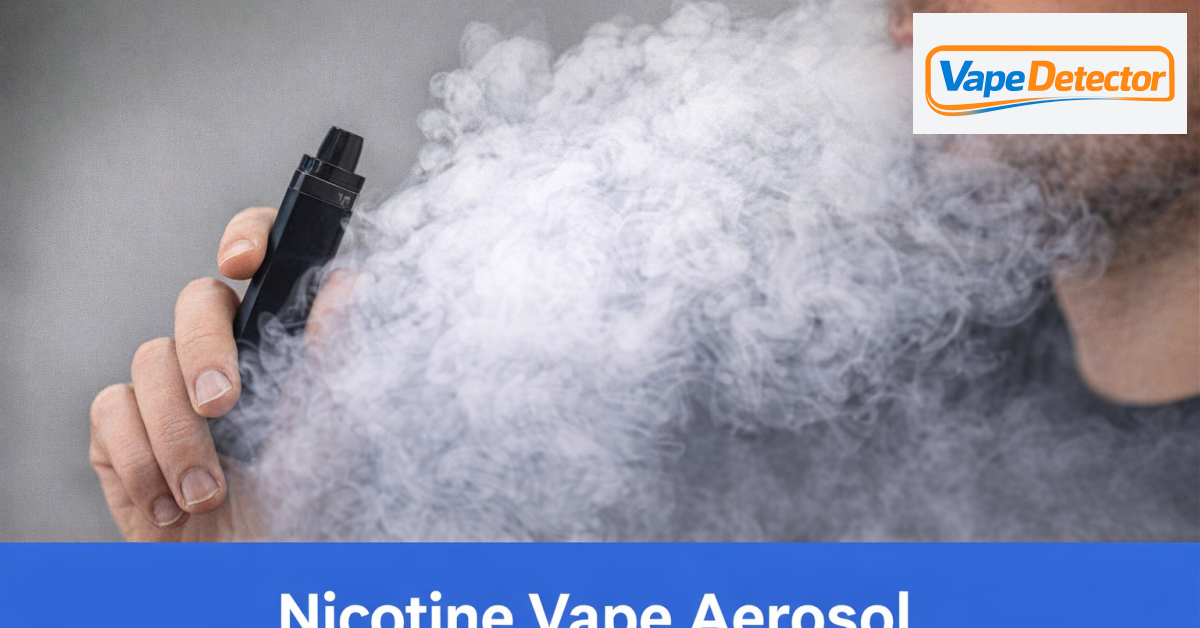
Nicotine Vape Aerosol
Nicotine vape aerosol is the airborne mixture produced when an e-cigarette heats e-liquid and a user inhales and exhales the resulting particles and gases. The term matters because exposure does not only involve the person vaping. Indoor air quality, residue on surfaces, and the practical need to detect and manage use in buildings all link back to how aerosol forms and behaves.
Nicotine vape aerosol also has regulatory and policy implications in the UK. Many organisations treat vaping similarly to smoking for workplace rules, safeguarding, and comfort, even when the legal framework differs across settings.
What Nicotine Vape Aerosol Is
Nicotine vape aerosol is a suspension of fine liquid droplets and gases created during vaping. Nicotine vape aerosol differs from “vapour” in the everyday sense because the visible cloud largely consists of tiny droplets, not only gas. The aerosol composition, particle size, and concentration change with device settings, e-liquid formulation, and user behaviour.
Clear terminology supports better decisions about indoor policies, ventilation, cleaning, and the selection of vape detectors. Nicotine vape aerosol also links to secondhand exposure because exhaled aerosol enters shared air.
You can find out more about what vape detectors detect in our dedicated guide.
Nicotine Aerosol Vs Smoke Vs Vapour
Cigarette smoke forms from combustion. Combustion creates a complex mixture of gases and solid particles (soot and tar) and produces high levels of by-products associated with burning. Nicotine vape aerosol forms from heating without combustion, so the process and typical by-products differ.
“Vapour” often describes the visible cloud from vaping, but the cloud is primarily droplets suspended in air. Nicotine vape aerosol behaves more like a mist than a purely gaseous vapour, so it disperses, deposits on surfaces, and changes over time.
What “Aerosol” Means In Vaping
An aerosol is a mixture of tiny particles or droplets suspended in a gas. In vaping, the gas is air mixed with volatile compounds, and the particles are mainly droplets from condensed e-liquid constituents.
Aerosol terminology matters for indoor management because droplets deposit on surfaces and fabrics. Deposition links vaping to cleaning needs and “thirdhand” residue, even when the visible cloud has cleared.
How Nicotine Vape Aerosol Forms
Nicotine vape aerosol forms when an e-cigarette heats e-liquid and creates a mix of gas-phase compounds and condensed droplets. The formation process affects particle size, visible density, and how far aerosol travels indoors. The same e-liquid produces different aerosol outputs across devices and settings.
Aerosol formation also determines what detectors and sensors “see”. Some sensors respond to particulate matter patterns, while others respond to volatile compounds, temperature changes, or airflow disturbances.
E-Liquid Heating And Aerosol Generation
A vaping device uses a powered heating element to raise the temperature of e-liquid delivered to a wick. Heat drives evaporation and partial decomposition of some components. Cooling in the airflow supports condensation into droplets, creating the aerosol that is inhaled.
Puff duration, airflow design, and coil temperature influence how much material becomes aerosol. Higher power settings often increase aerosol mass per puff, even when nicotine strength stays the same.
Factors That Change Aerosol Output
Device power, coil resistance, and airflow settings change heating dynamics. E-liquid composition also changes output, particularly the ratio of propylene glycol (PG) to vegetable glycerine (VG), nicotine formulation, and flavourings.
User behaviour changes aerosol output through puff frequency, puff duration, and inhalation style. A short, low-power puff produces a different aerosol profile from a long, high-power puff, even on the same device.
Environmental Conditions And Aerosol Behaviour
Indoor temperature and humidity affect droplet evaporation and persistence. Ventilation rate controls how quickly aerosol dilutes and exits the room. Air movement from fans and HVAC systems shapes where aerosol travels and where residue deposits.
Room geometry also matters. Smaller rooms with low air change rates reach higher concentrations more quickly, and aerosol reaches surfaces faster due to shorter travel distances.
What Nicotine Vape Aerosol Contains
Nicotine vape aerosol contains nicotine in droplets and in gas-phase forms, plus carrier solvents and a range of minor constituents. Composition varies by e-liquid, device temperature, and how the aerosol ages in air. The presence of nicotine is central to dependence risk and to safeguarding concerns in shared spaces.
Aerosol composition also affects odour, irritation potential, surface residue, and sensor response. Some compounds deposit readily, while others disperse and ventilate out more quickly.
Nicotine Delivery In Aerosol Droplets
Nicotine transfers into aerosol droplets during heating and condensation. The nicotine dose a user receives depends on aerosol mass inhaled and nicotine concentration in the liquid, as well as how efficiently nicotine deposits in the respiratory tract.
Nicotine formulation affects delivery. Freebase nicotine and nicotine salts differ in pH and sensory effects, which influences how users puff and how much aerosol they inhale.
Common Aerosol Constituents From E-Liquids
Propylene glycol and vegetable glycerine are common carriers and form a large share of aerosol droplets. Water, ethanol, and other solvents appear in some formulations. Flavouring compounds vary widely across products.
The aerosol also includes exhaled breath components such as carbon dioxide and moisture. Exhaled aerosol therefore differs from the inhaled aerosol because the user retains and transforms part of what is inhaled.
By-Products From Heating And Device Components
Heating generates thermal decomposition by-products at varying levels depending on temperature, coil condition, and e-liquid composition. Overheating, poor wicking, or degraded coils increase the likelihood of unpleasant “dry hit” conditions and changes in by-product profile.
Device components also influence aerosol through metals and other materials in the heating assembly and airflow path. Poor-quality components and heavy use raise the risk of wear-related emissions, although levels vary and depend on product design and condition.
What “Secondhand Aerosol” Typically Includes
Secondhand aerosol is the exhaled mixture that enters the environment. Secondhand aerosol usually contains diluted droplets of PG/VG, residual nicotine, flavouring traces, and breath-derived moisture and gases.
Secondhand aerosol composition changes quickly. Droplets evaporate, deposit on surfaces, and dilute through ventilation, so concentration and particle size distribution shift within minutes in many indoor settings.
Nicotine Vape Aerosol Exposure Pathways
Nicotine vape aerosol exposure occurs through inhalation of airborne droplets and gases, and through contact with deposited residue. Exposure pathways matter in shared indoor settings such as schools, toilets, transport hubs, healthcare sites, and workplaces. The pathway influences the control measure, whether that is ventilation, rule enforcement, cleaning, or monitoring.
Exposure discussions also need precision. “Secondhand” refers to breathing shared air during or soon after vaping, while “thirdhand” refers to residue that remains after the visible cloud has gone.
Direct Inhalation And Dose Drivers
Direct inhalation involves aerosol entering the lungs during vaping. Dose depends on nicotine concentration, device power, puff topography, and how deeply and frequently a person inhales.
User experience affects intake. Stronger throat hit, device airflow, and nicotine formulation influence puffing patterns, which changes aerosol volume inhaled per session.
Secondhand Exposure In Indoor Spaces
Secondhand exposure occurs when non-users breathe air that contains exhaled aerosol. Concentrations depend on room size, number of users, duration of use, proximity, and ventilation rate.
Enclosed spaces concentrate exposure. Toilets, stairwells, changing rooms, and vehicles often have limited ventilation and short distances to occupants, which increases the likelihood of noticeable aerosol and odour.
Thirdhand Residue On Surfaces And Fabrics
Thirdhand residue forms when aerosol droplets deposit on walls, floors, desks, soft furnishings, and clothing. Residue includes nicotine and other semi-volatile compounds that can persist and re-emit into air under some conditions.
Cleaning practices influence residue persistence. Porous materials retain residue more readily than hard, wipeable surfaces, and repeated use in the same space increases cumulative build-up.
Health And Safety Considerations
Health and safety considerations focus on nicotine exposure, respiratory irritation, accidental poisoning risks, and safeguarding in sensitive environments. Vaping products are regulated differently from combustible tobacco, but nicotine remains a pharmacologically active substance with dependence potential.
Building operators often prioritise clear rules and consistent enforcement because disputes typically arise from odour, perceived air quality impacts, and concerns about children and vulnerable people.
Nicotine Pharmacology And Dependence Risk
Nicotine is a stimulant that acts on nicotinic acetylcholine receptors in the brain. Nicotine exposure supports dependence, and dependence drives repeated use.
Nicotine concentration, delivery efficiency, and frequency of use influence dependence risk. Nicotine salts often enable higher nicotine strengths with reduced harshness, which changes user behaviour and potential intake patterns.
Irritation And Respiratory Effects
Propylene glycol and some flavouring compounds irritate the throat, eyes, or airways in some people. Indoor aerosol also affects comfort through odour and perceived “staleness” of air, especially in confined spaces.
Sensitive individuals may experience symptoms more readily. Asthma and other respiratory conditions often correlate with greater sensitivity to airborne irritants, even at low concentrations.
Vulnerable Groups And Higher-Risk Settings
Children and adolescents represent a safeguarding priority because nicotine exposure relates to dependence risk and product misuse. Healthcare settings, care homes, and schools often apply stricter rules to protect vulnerable occupants and to maintain predictable indoor air quality.
Pregnancy is also a relevant context for nicotine risk management. Organisations frequently apply precautionary approaches in maternity-related settings because nicotine has known pharmacological effects.
Poisoning Risks From Nicotine Liquids And Residue
Nicotine e-liquids pose poisoning risk if swallowed or absorbed through the skin, especially for children. Spills on surfaces and leakage from devices create contact risks, particularly in homes, schools, and vehicles.
Residue on surfaces contributes a lower-level exposure route than ingestion, but residue still matters for hygiene and for environments where children touch surfaces and then touch their mouth.
Nicotine Vape Aerosol Detection And Monitoring
Nicotine vape aerosol detection focuses on identifying use in indoor spaces and supporting policy enforcement. Detection also supports safeguarding objectives in places where vaping is prohibited, such as school toilets and certain workplace areas. Monitoring approaches vary from simple alarms to networked sensors that support incident logs.
Detector performance depends on what the sensor measures and how the environment behaves. High airflow, open doors, and competing aerosols from cleaning products affect detection reliability.
What Vape Detectors Measure
Vape detectors measure signals associated with vaping events rather than “nicotine” directly in many deployments. Common targets include changes in particulate concentration, volatile organic compounds patterns, and environmental changes such as temperature, humidity, and air movement.
Alarm logic usually relies on multiple inputs and thresholds. Multi-sensor approaches reduce nuisance alarms compared with a single-sensor trigger, depending on calibration and placement.
Sensor Types Used For Aerosol-Related Detection
Optical particle sensors detect airborne particulate or droplet concentrations and changes over baseline. Gas sensors respond to volatile compounds that correlate with vaping aerosol, although many volatiles also come from sprays, deodorants, and cleaning chemicals.
Some systems combine sensors and apply pattern recognition to distinguish vaping from other sources. Networked detectors often add tamper detection and event reporting for operational follow-up.
Placement Considerations For Indoor Detection
Detector placement affects sensitivity and false positives. Toilets and enclosed rooms often require placement away from direct extraction vents because vents remove aerosol rapidly and reduce the local signal.
Mounting height, distance from doors, and airflow patterns matter. Detectors placed near sources of steam or aerosols such as hand dryers, showers, or spray use often record more nuisance triggers.
Limits Of Detection And Common False Positives
Detection limits arise from dilution, ventilation, and short vaping events. A single puff near an open door or under strong extraction reduces the measurable signal.
False positives commonly relate to aerosols and volatiles from deodorant sprays, cleaning chemicals, steam, and dust disturbances. Operational settings often reduce false positives through placement changes, sensitivity adjustments, and clear site rules about aerosol sprays.
UK Rules And Policies That Relate To Vape Aerosol
UK rules affecting vaping indoors come from a mix of legislation, sector guidance, and site policies. The smokefree law primarily targets smoking of tobacco in enclosed workplaces and public places, while vaping rules often sit within employer policies and venue terms. Policies usually aim to protect comfort, safety, and safeguarding needs.
Organisations also need to treat monitoring responsibly. Sensor deployment links to privacy, data handling, and clear communication to occupants.
Indoor Air Policies In Workplaces And Public Venues
Employers set workplace vaping policies under health and safety management and duty of care considerations. Many employers restrict vaping indoors to avoid nuisance, complaints, and uncertainty about exposure, even where law does not explicitly prohibit vaping in the same way as smoking.
Public venues often apply house rules that prohibit vaping indoors. Transport operators, hospitality venues, and shopping centres commonly treat vaping as a behaviour managed through conditions of entry.
Signage, Enforcement, And Record-Keeping
Signage supports compliance when it states whether vaping is permitted, where it is permitted, and what the consequences are for breaches. Consistent enforcement reduces repeat incidents and reduces disputes between staff and users.
Record-keeping supports operational response. Incident logs and maintenance records for detectors help identify repeat locations, tampering, and periods of elevated risk.
Data Protection Considerations For Sensor Use
UK data protection obligations apply when monitoring identifies individuals or links events to identifiable people. Networked vape detectors that store event times, locations, and device identifiers require an assessed lawful basis and proportionate use.
Clear notices and internal policies support compliant use. Access control, retention limits, and documented purpose reduce the risk of over-collection and misuse of monitoring data.
Practical Steps To Reduce Unwanted Exposure
Reducing unwanted exposure to nicotine vape aerosol relies on a mix of engineering controls, housekeeping, and clear behavioural rules. The most effective approach matches the setting, occupancy, and risk profile, particularly where children or vulnerable occupants are present. Practical steps also reduce nuisance impacts such as odour and visible clouds.
Operational controls work best when they are easy to follow and easy to enforce. Consistent rules reduce covert use and reduce the need for repeated interventions.
Ventilation And Room Management
Ventilation reduces indoor aerosol concentration by dilution and removal. Mechanical extraction in toilets and good air changes in small rooms reduce persistence, although strong extraction also moves aerosol into ducts and adjacent spaces if airflow is poorly balanced.
Room management reduces exposure opportunities. Closing off high-risk areas, monitoring repeated hotspots, and keeping doors closed or open depending on airflow design changes aerosol movement and build-up.
Cleaning And Surface Decontamination
Routine cleaning removes deposited residue from hard surfaces. Frequent wiping of touchpoints such as door handles, cubicle locks, desks, and windowsills reduces thirdhand build-up.
Soft furnishings retain residue more readily than hard surfaces. Fabric cleaning schedules and restrictions on vaping in carpeted or upholstered areas reduce long-term odour and residue persistence.
Device Use Rules In Buildings And Vehicles
Clear rules about where vaping is permitted reduce disputes and reduce covert use. Rules often specify designated outdoor areas, minimum distances from entrances, and restrictions in shared vehicles.
Vehicles require tighter controls because of confined volume and limited ventilation. A single vaping event in a car, minibus, or van produces higher concentrations than the same event in a large room.
FAQs
What Is The Difference Between Nicotine Vape Aerosol And Vapour?
Nicotine vape aerosol is the mixture of tiny droplets and gases produced by an e-cigarette. “Vapour” is often used as a general term, but the visible cloud from vaping is mainly droplets suspended in air, which fits the definition of an aerosol.
Nicotine vape aerosol terminology is useful because aerosols deposit on surfaces and behave differently from a purely gaseous vapour.
Does Nicotine Vape Aerosol Linger In A Room?
Nicotine vape aerosol lingers longer in poorly ventilated rooms and shorter in well-ventilated rooms. Room size, air change rate, and air movement control how quickly concentrations fall.
Aerosol visibility is not a reliable indicator of persistence. Some components deposit on surfaces quickly, while others remain in air at lower, less visible levels.
Is Secondhand Nicotine Vape Aerosol Detectable?
Secondhand nicotine vape aerosol is detectable with appropriate sensors under the right conditions. Many vape detectors detect particulate and volatile patterns associated with vaping events rather than nicotine specifically.
Detection reliability depends on proximity, ventilation, and competing aerosols such as deodorant sprays and steam.
Do Air Purifiers Remove Nicotine Vape Aerosol?
HEPA-type filtration captures many airborne droplets and particles. Activated carbon media adsorbs some gases and odour-causing compounds, depending on filter design and saturation.
Air purifiers do not replace ventilation and behavioural controls. Air purifiers also do not reliably prevent residue formation because deposition continues while vaping occurs.
What Affects How Much Nicotine Aerosol A Person Inhales?
Nicotine aerosol intake depends on nicotine strength, device power, coil temperature, airflow, puff duration, and puff frequency. Nicotine formulation also influences puffing behaviour because sensory effects affect how a person uses the device.
Individual factors such as inhalation depth and frequency of sessions also change total daily exposure.
Conclusion
Nicotine vape aerosol is a droplet-and-gas mixture produced by heating e-liquid, and it behaves differently from smoke and from a purely gaseous vapour. Aerosol formation, composition, and indoor behaviour determine exposure pathways, including direct inhalation, secondhand breathing, and thirdhand residue on surfaces.
Organisations manage nicotine vape aerosol through indoor policies, ventilation and cleaning practices, and proportionate detection where safeguarding or compliance demands it. Clear terminology and clear rules support consistent decisions in UK indoor environments.