
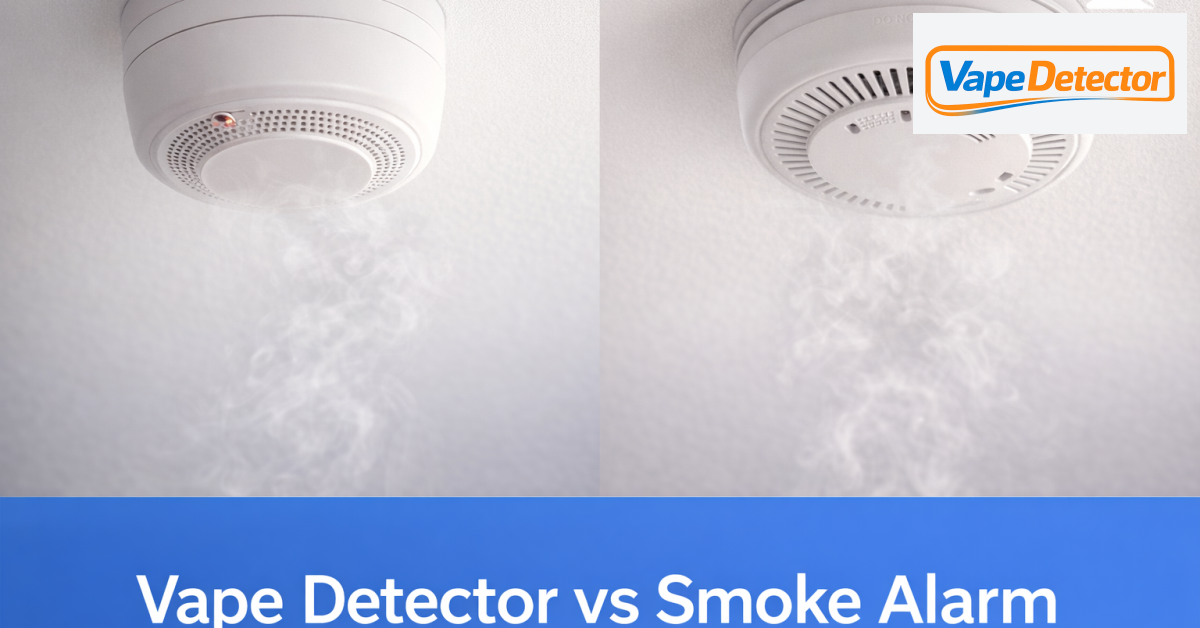
Vape Detector vs Smoke Alarm
Vape detectors and smoke alarms serve different purposes in UK buildings. A vape detector identifies vaping-related aerosols to support policy enforcement and reduce nuisance behaviour in places such as toilets, corridors, and bedrooms. A smoke alarm detects smoke from fire and forms part of life safety measures that support safe evacuation and fire response.
Choosing between the two depends on the risk being managed. Fire risk requires compliant fire detection and warning. Vaping risk relates to behaviour management, indoor air rules, and safeguarding, with different alerting needs and different legal considerations.
Key Differences At A Glance
Vape detectors focus on identifying vapour aerosols associated with e-cigarettes and similar devices, often with discreet alerts to staff. Smoke alarms focus on early warning of fire, usually with loud local sounders and optional interlinking to alert occupants.
Vape detectors often prioritise event logging, remote notifications, and location reporting. Smoke alarms prioritise audibility, reliability, and compliance with fire safety standards and building fire strategies. Both devices use sensing methods that react to airborne particles, but they target different conditions and are specified, installed, and maintained for different outcomes.
What A Vape Detector Is
A vape detector is a sensor device that identifies airborne aerosol signatures associated with vaping in a defined area. A vape detector supports rule enforcement and incident response in locations where vaping is prohibited or creates a safeguarding or operational issue.
Vape detector choice affects how quickly staff receive an alert, how accurately the location is reported, and how well the device copes with humidity and other airborne particles. Vape detector selection also affects data handling if the detector records events or transmits alerts over a network. A vape detector addresses behavioural risk rather than fire risk.
What A Vape Detector Detects
Vape detectors detect aerosol particulates and related compounds produced by e-cigarettes and some heated products. Vape aerosol often contains fine particles and volatile compounds that vary by device type, liquid, and user behaviour.
Vape detector performance depends on the sensor approach and the environment. Toilets, changing rooms, and small bedrooms often concentrate aerosols quickly, which supports faster detection. Large, ventilated spaces dilute aerosols, which reduces sensitivity and increases the importance of placement.
Where Vape Detectors Get Installed
Schools and colleges often install vape detectors in toilets, stairwells, and changing areas. Student accommodation and hotels often install vape detectors in bedrooms and corridors where smoking and vaping restrictions apply.
Healthcare sites and public venues often use vape detectors in toilets and concealed areas where staff presence is limited. Placement typically prioritises areas with repeat incidents, limited supervision, and limited natural ventilation.
Typical Alert And Reporting Options
Vape detectors often provide silent alerts to reduce disruption and avoid escalation. Many devices support time-stamped event logs, device health reporting, and zone-based location information.
Reporting commonly supports operational follow-up. Reporting usually includes alert type, date and time, detector ID, and connectivity status where the device is networked.
You can read all about vape detector basics if you need more information.
What A Smoke Alarm Is
A smoke alarm is a fire detection device that identifies smoke from combustion and triggers an audible alarm to warn occupants. Smoke alarms form part of domestic fire safety and, in larger or higher-risk buildings, connect into broader fire detection and alarm arrangements.
Smoke alarm selection affects detection speed for different fire types, false alarm rates, and suitability for specific environments such as kitchens, corridors, and sleeping areas. Smoke alarms address life safety and fire response, with requirements that link to UK fire safety duties and building design.
What Smoke Alarms Detect
Smoke alarms detect smoke particles produced by fires. Different technologies respond differently to smouldering fires versus flaming fires, and the choice of alarm type affects performance in real conditions.
Smoke alarms do not aim to identify rule-breaking or minor aerosol events. Smoke alarm activation triggers an emergency response expectation, which makes correct specification and placement essential.
Where Smoke Alarms Get Installed
Homes usually place smoke alarms on escape routes and in areas that align with fire safety advice and product instructions. Landlords follow relevant legal duties for smoke alarm provision in rented properties, with placement often focused on hallways, landings, and living areas.
Non-domestic buildings often use systems designed as part of a fire risk assessment, fire strategy, and British Standard aligned design. Smoke detection in commercial sites often uses multiple detectors across zones, with sounders and controls that support evacuation.
Typical Alarm Sound And Interlinking Options
Smoke alarms typically use a loud on-device sounder to alert nearby occupants. Many alarms support interlinking so that activation in one area triggers alarms in other areas, which helps alert occupants on different floors or in separate rooms.
Interlinking uses hard-wired interconnect, wireless interconnect, or connection to a central fire alarm system, depending on the building type and fire design.
Detection Method And Sensor Technology
Both device types rely on sensing airborne changes, but the target signatures and the decision thresholds differ. Vape detection aims to spot aerosol events linked to prohibited use, while smoke detection aims to spot early signs of fire with a clear warning response.
Sensor choice influences reliability, nuisance activations, and the maintenance regime. Building conditions such as ventilation, humidity, dust, deodorant sprays, and steam affect both types of devices and affect specification decisions.
Aerosol And Particulate Detection For Vaping
Vape detectors often use particulate sensing that responds to fine aerosols and changes in air quality. Some devices combine multiple sensors to improve classification and reduce mis-triggers from common bathroom aerosols.
Detection performance depends on how the device distinguishes vaping aerosols from other particulates. Effective configuration often relies on suitable placement and thresholds matched to the environment rather than maximum sensitivity in every location.
Optical And Ionisation Smoke Detection
Optical smoke detection responds well to many smouldering fire scenarios because it detects light scattering caused by smoke particles. Ionisation smoke detection reacts strongly to some fast-flaming fire signatures but is less common in new UK specifications due to practical and environmental considerations.
Smoke detector choice follows risk and environment. Kitchens, shower rooms, and dusty areas often require different detector types or siting decisions to reduce nuisance alarms while maintaining safety.
False Alarms And Environmental Sensitivity
Vape detectors commonly face triggers from aerosols such as deodorant sprays, steam, dust, and cleaning products, depending on the sensor design and settings. Smoke alarms commonly face triggers from cooking fumes, steam, and aerosols, especially when incorrectly sited near kitchens or bathrooms.
Environmental sensitivity requires matching device type and location to the conditions. A correct choice reduces disruptions, reduces unnecessary call-outs, and improves trust in alarms and alerts.
Response And Alerts
Alerting design differs because the purpose differs. Smoke alarms prioritise immediate occupant warning and evacuation signals. Vape detectors prioritise timely staff intervention with minimal disruption and clear location reporting.
Response design affects staffing, escalation procedures, and integration with site policies. Buildings with limited staffing often value remote notifications and escalation routing for vape incidents.
On-Device Alarms Vs Silent Alerts
Vape detectors often use silent alerts or discreet local indicators to avoid signalling to the person vaping. Some sites use local sounders for deterrence, but that approach increases disruption and may increase tampering risk.
Smoke alarms use audible alarms as the primary outcome. Audible alarms support evacuation and alert sleeping occupants, which makes volume, interlinking, and audibility central considerations.
Notifications To Staff Or Security Teams
Vape detectors often send notifications to designated staff, reception teams, caretakers, or security staff. Notifications typically include the detector location and time so staff can respond quickly and safely.
Notification routing matters in multi-storey buildings and multi-site estates. A well-defined response process reduces repeated incidents and supports consistent enforcement.
Integration With Fire Alarm And Building Systems
Some vape detectors integrate with building management systems or security dashboards for central monitoring. Some installations support relay outputs or other interfaces, but integration design requires care to avoid confusion between behaviour alerts and fire alarms.
Fire alarm integration follows strict design and commissioning practices. Any connection between non-fire sensors and fire alarm systems requires competent design so that a vape event does not create an inappropriate fire evacuation signal.
Use Cases In UK Buildings
Building type influences both the risk profile and the practical response options. Sites with safeguarding duties and high footfall often prioritise vape detection in concealed areas. Sites with sleeping risk prioritise compliant fire detection and warning, with vaping controls used as a secondary measure.
A building’s incident history, staffing model, and physical layout influence which device delivers meaningful outcomes. Clear use cases reduce unnecessary spend and reduce operational disruption.
Schools, Colleges, And Universities
Schools often use vape detectors to support safeguarding and to reduce unsupervised vaping in toilets and changing areas. Colleges and universities often target halls of residence and toilets in high-traffic academic buildings.
Education sites often require discreet alerts to pastoral teams, duty staff, or security. Education sites also benefit from tamper monitoring and clear location identifiers to reduce time spent investigating alerts.
Hospitals And Healthcare Settings
Hospitals often manage vaping to protect vulnerable patients and to maintain clean air policies. Healthcare sites often focus on toilets, entrances, and low-visibility corridors where enforcement is difficult.
Healthcare sites also require careful consideration of alarm noise and patient impact. Discreet notification routes often suit clinical environments where unnecessary noise disrupts care.
Hotels, Student Accommodation, And HMOs
Hotels often use vape detectors to support no-smoking room policies and reduce cleaning costs and guest complaints. Student accommodation often uses vape detectors to reduce corridor haze, fire risk behaviours, and repeated policy breaches in bedrooms and communal areas.
HMOs often have mixed occupancy patterns and variable supervision. Fire detection remains the primary safety control in HMOs, with vape detection used to support behavioural controls where incidents persist.
Offices, Retail, And Public Venues
Offices often focus vape detection on toilets, stairwells, and lift lobbies. Retail and public venues often focus on customer toilets and back-of-house areas where staff presence varies.
Public venues often prioritise quick, discreet alerts to on-site teams. The practical value depends on whether staff can respond quickly and safely.
Compliance, Safety, And Legal Considerations In The UK
Smoke alarms link directly to fire safety duties and legal expectations around warning and evacuation. Vape detectors link more closely to policy enforcement, safeguarding, and building rules, with added considerations where devices connect to networks or store event data.
Legal and compliance checks reduce the risk of installing a device that creates confusion, creates privacy concerns, or fails to support the intended outcome. Clear governance supports consistent staff response and defensible procedures.
Fire Safety Duties And Smoke Alarm Requirements
Fire safety responsibilities in the UK depend on building type, occupancy, and the relevant legislation and guidance. Smoke alarm requirements in rented homes and fire detection requirements in non-domestic buildings often differ in detail, but both focus on early warning and safe evacuation.
A fire risk assessment typically informs detector types, siting, testing, and evacuation arrangements in non-domestic buildings. Smoke alarms and fire alarm systems require correct selection, correct installation, and routine testing to remain effective.
Vaping Policies And Enforcement Considerations
Vape detectors support a site’s vaping policy by providing evidence of time and location for an incident response. A clear policy reduces disputes and supports consistent action across staff teams.
Enforcement works best when the building has a defined response process, clear signage where appropriate, and a record of repeated hotspots. A vape detector does not replace supervision or wider safeguarding processes.
Privacy And Data Protection For Connected Devices
Connected vape detectors often transmit alerts, device identifiers, and event logs. Data protection compliance depends on what data is collected, how long it is stored, who can access it, and whether the system identifies individuals.
UK GDPR and the Data Protection Act 2018 apply where personal data is processed. Schools, employers, and accommodation providers often need clear documentation for monitoring measures, including purpose limitation, access controls, retention, and transparency measures.
Installation, Maintenance, And Ongoing Costs
Installation and maintenance determine whether detection remains reliable over time. Vape detectors rely on suitable placement and sensible thresholds for the environment. Smoke alarms rely on compliant siting, routine testing, and timely replacement.
Ongoing costs include device replacement cycles, network subscriptions where used, staff time for responding to alerts, and contractor servicing where required. A realistic maintenance plan reduces nuisance activations and reduces the risk of non-functional devices.
Installation Complexity And Placement Considerations
Vape detector installation varies by model and building construction. Ceiling height, ventilation direction, and room volume affect detection time and accuracy, which makes placement a practical design decision rather than a purely aesthetic one.
Smoke alarm installation ranges from simple domestic fitting to designed and commissioned fire alarm systems in larger buildings. Placement follows manufacturer instructions and, for system detection, the building’s fire strategy and design standards.
Testing, Calibration, And Routine Checks
Vape detectors often require functional checks that confirm sensing, alerting, and connectivity status. Routine checks also include tamper inspection and verification that the device remains correctly sited and unobstructed.
Smoke alarms require regular user testing and periodic maintenance depending on the type of system. Battery condition, end-of-life replacement, and detector contamination checks affect reliability.
Power, Connectivity, And Reliability Considerations
Vape detectors may use mains power, battery power, or Power over Ethernet, depending on model and site constraints. Networked detectors also depend on Wi‑Fi, Ethernet, or cellular connectivity, which introduces coverage and outage risks.
Smoke alarms often use battery, sealed long-life battery, or mains with battery back-up. Fire alarm systems use dedicated power supplies and monitored fault reporting, which supports higher resilience.
How To Choose Between A Vape Detector And A Smoke Alarm
The correct choice depends on whether the building needs behaviour detection, fire detection, or both. Vape detectors manage vaping incidents and policy breaches. Smoke alarms manage fire detection and occupant warning.
A clear risk-led approach supports better placement, fewer false alarms, and a response process that matches the building’s staffing and occupancy. The decision also affects procurement, integration design, and maintenance responsibilities.
When A Vape Detector Fits The Risk
A vape detector fits the risk where vaping creates repeated safeguarding, hygiene, or operational issues in areas with limited supervision. Toilets, stairwells, bedrooms, and changing rooms often fall into this category.
A vape detector also fits where discreet notification matters more than audible deterrence. Sites with staffed response teams gain more value from accurate location reporting and reliable alert routing.
When A Smoke Alarm Fits The Risk
A smoke alarm fits the risk where early fire warning is required to protect life and support evacuation. Sleeping areas, escape routes, and higher-risk rooms require appropriate fire detection and warning arrangements.
A smoke alarm also fits where compliance obligations apply for domestic rented property or where the building uses a fire detection and alarm system designed around a fire risk assessment.
When Both Are Required In The Same Building
Many UK buildings require smoke detection for life safety and also face persistent vaping in prohibited areas. Using both devices separates the life safety function from behaviour monitoring and reduces the risk of confusing signals and responses.
A combined approach works best when each device has a defined purpose, a defined response process, and clear rules for any system integration and escalation.
FAQs
Do Vape Detectors Replace Smoke Alarms?
Vape detectors do not replace smoke alarms. Smoke alarms provide life safety warning for fire, and vape detectors support vaping policy enforcement and incident response.
Do Vape Detectors Detect Cigarette Smoke Or Cannabis Smoke?
Some vape detectors respond to aerosols or particulates from cigarette smoke or cannabis smoke, but performance varies by device and settings. A specification check with the manufacturer’s detection claims and limitations provides the most reliable answer for a specific model and environment.
Do Smoke Alarms Detect Vaping?
Smoke alarms sometimes trigger on heavy vapour or aerosol in confined spaces, but smoke alarms are not designed to reliably detect vaping. Smoke alarm response to vapour also varies by detector type, placement, and ventilation.
Where Should A Vape Detector Be Installed For Best Results?
A vape detector usually performs best in enclosed, high-incident areas such as toilets, cubicles, changing rooms, and corridors outside those spaces. Placement follows the manufacturer’s guidance and accounts for ventilation supply and extract points to avoid delayed detection or nuisance triggers.
Are Vape Detectors Legal In Schools And Toilets In The UK?
Vape detectors are lawful to use in UK schools and toilets where the deployment meets safeguarding needs and data protection duties. Privacy compliance depends on what the device records and how the school documents purpose, access, retention, and transparency.
Can A Vape Detector Link To A Fire Alarm Panel?
Some vape detectors support interfaces that connect to other building systems, but linking directly to a fire alarm panel requires careful design to avoid inappropriate fire signals. A competent fire alarm designer or contractor provides the safest route for any integration that affects fire alarm inputs or evacuation behaviour.
Conclusion
Vape detectors and smoke alarms address different risks in UK buildings. Vape detectors support enforcement and safeguarding by identifying vaping-related aerosols and sending discreet alerts to staff. Smoke alarms provide early warning of fire and support evacuation through audible alarms and, where used, interlinking or system signalling.
A risk-led choice based on building use, occupancy, staffing, and compliance duties produces the most reliable outcome. Many sites use both devices to separate life safety fire detection from vaping incident management and to maintain clear response procedures.